
Contributions and dues
Before you start, sign in and open Members / Membership / Member Contributions (you will also use Members / Membership / Memberships, Members / Membership / Member Payment Requests, Members / Reports / Membership Reports, and Cash / Money / Transactions).
Can’t find it? It may be turned off for your business, or your account may not be allowed to open it. Ask the person who set up your FeePrime. They can fix both.
Photo: Carlos Urrutia on Unsplash
Picture the monthly meeting of the Douala Bakers Guild. Amina from Sunrise Bakery is the treasurer. She opens her cashbook and announces that 370,000 XAF came in this month for the 10,000 XAF solidarity fund. Right away, the chair asks the question every committee asks: “Good — now which eight members still have not paid?”
If you only write down the money that arrives, you can answer the first question and never the second. You spend Sunday afternoon flipping through notebooks, checking Mobile Money texts, and hoping you do not accidentally chase Nadège Fouda when she already paid Paul in cash two weeks ago.
Member Contributions fixes that in one stroke. It is where you record what each member is expected to pay — so FeePrime can match it against what actually came in and tell you in seconds who is up to date and who is still missing.
1. What a contribution holds
Open Members / Membership / Member Contributions to set up a contribution. Each contribution record carries five simple pieces of information:
- Name — plain words saying what the money is for (for example, Monthly Solidarity Fund or 2026 Cold-Room Building Fund).
- Expected amount per member — the figure each qualifying member owes, such as 10,000 XAF or 25,000 XAF.
- Frequency — one time, monthly, or yearly.
- Deadline — the date by which the money is due.
- Mandatory for membership types — which kinds of member have to pay it (set up under Members / Membership / Membership Types).
That last setting is what makes contributions work for real organisations. In the Douala Bakers Guild:
- The 10,000 XAF monthly solidarity fund is mandatory for every active membership type.
- The 25,000 XAF one-time cold-room building fund is mandatory for Full Members only — Student Members and Honorary Members do not owe it.
- The 15,000 XAF yearly trade-fair levy is mandatory only for Shop-Owner Members who take a stall.
Instead of keeping three separate spreadsheets and crossing names out by hand, you set the rule once and let FeePrime know who owes what.
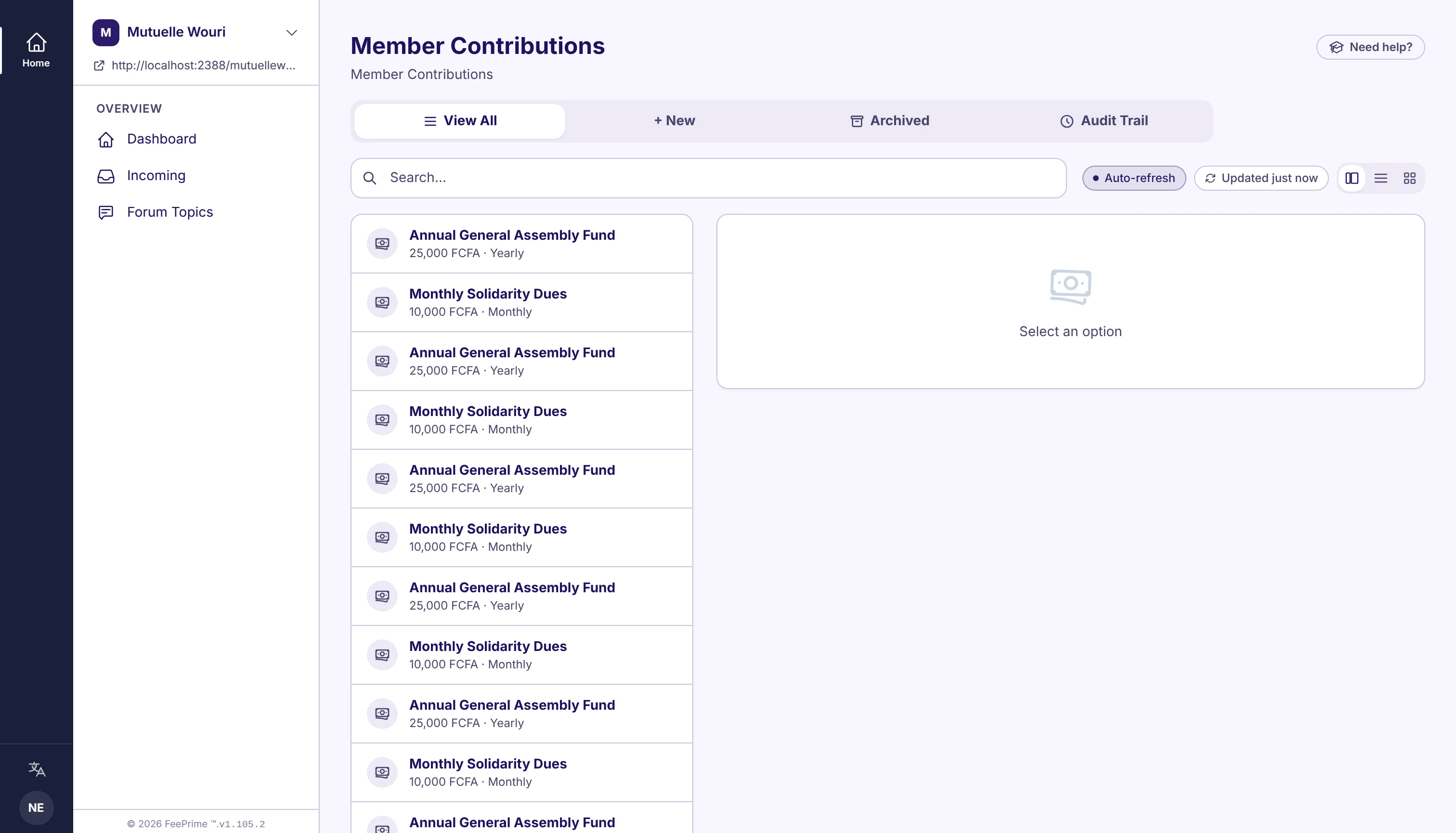 member contributions screen in FeePrime (Mutuelle Wouri).
2. Keep what you expect separate from what actually arrives
The whole trick to clean dues tracking is keeping two things apart:
- What should come in lives in Members / Membership / Member Contributions.
- What actually came in is recorded as a payment in Cash / Money / Transactions, just like any other incoming cash or Mobile Money receipt.
Here is how the pieces fit together from start to finish:
  Members / Membership / Member Contributions
  (What SHOULD come in: 10,000 XAF x 45 Full Members)
                        |
                        v
  Members / Membership / Member Payment Requests
  (Optional: send a clear payment request to members)
                        |
                        v
  Cash / Money / Transactions
  (What ACTUALLY arrived: 37 payments = 370,000 XAF)
                        |
                        v
  Members / Reports / Membership Reports
  (Clear summary: 37 paid  |  8 still missing)
Never skip writing down what is expected. Cash transactions alone give you a total and nothing else. The contribution record is the yardstick that turns raw receipts into a live paid-vs-missing list.
3. Keep contributions separate from membership fees
It is tempting to lump everything a member pays into one line, especially when someone hands over cash for two things on the same morning. Resist that habit.
- A membership fee pays for being a member — it says Nadège Fouda is a Full Member until 31 December.
- A contribution is money owed because you are a member — a solidarity fund, a building levy, or a shared project the group is funding together.
Suppose Nadège stops by Sunrise Bakery and hands Amina 60,000 XAF: 40,000 XAF for her annual membership renewal and 20,000 XAF for the trade-fair levy. Never lump a renewal fee and a contribution into one single entry. If Paul records 60,000 XAF under membership fees just to finish faster, the membership total looks inflated, the trade-fair fund looks short by 20,000 XAF, and Nadège shows up as unpaid on the levy list.
Committees always ask about membership renewals and special funds separately. Record them separately from day one and you never have to untangle them at the annual general meeting.
4. Pick a deadline you will actually act on
Every contribution has a deadline, and that date only works if your committee treats it as real.
Never set a deadline nobody enforces. If your rule says dues are due on the 5th of every month, but nobody checks the report or sends a single reminder until November, you have trained your members to ignore the 5th. Next year they will ignore the next deadline too.
Choose a date you have the time to follow up on — even if that means the 15th instead of the 1st — and agree on one simple habit after that date passes:
- Check the summary in Members / Reports / Membership Reports.
- Send a quick follow-up or use Members / Membership / Member Payment Requests for those who have not paid yet.
- Share the total collected at the next meeting under Members / Engagement / Meetings.
One modest deadline you act on every month is worth five strict deadlines everyone ignores.
5. Follow up early and gently
When you open Members / Reports / Membership Reports in week two and see eight names still missing, remember what kind of list you are looking at.
Chasing members is not debt collection. In a cooperative, guild, church group, or alumni club, the unpaid list is almost always made up of people who got busy, travelled upcountry, missed the announcement, or had a hard month with a broken oven. It is rarely someone trying to cheat the group.
- A warm reminder in week two is a kindness. Most members thank you and pay the same afternoon.
- An angry demand in month six is a fight. By then the balance has piled up, embarrassment sets in, and you often lose the member as well as the money.
Use the report early, keep the tone human, and protect the relationship first.
6. Start simple — add structure only as your group grows
Not every group needs every screen in the Members menu on day one.
- Small club or savings group (10–30 members, one flat due)? Create a single Member Contribution tied to your one membership type, log incoming payments in Cash / Money / Transactions, and review Members / Reports / Membership Reports once a month. Leave extra membership types, Member Payment Requests, and Member Portals off for now. Nothing breaks.
- Larger guild, cooperative, or multi-city association? Define clear Membership Types (Full, Associate, Student, Regional) so each levy automatically applies only to the right members, use Members / Membership / Member Payment Requests to request payment without chasing people one by one, and let members check their own status through Members / Membership / Member Portals.
Try it
Sign in to staging.feeprime.com — a practice copy of FeePrime, kept apart from the real thing — and run through this five-minute drill:
- Open Members / Membership / Membership Types and confirm you have at least two types (for example, Full Member and Student Member).
- Go to Members / Membership / Member Contributions and create a monthly contribution of 10,000 XAF with a deadline ten days from today, marked mandatory for Full Member only.
- Check Members / Membership / Memberships to note two active Full Members and one Student Member.
- Open Cash / Money / Transactions and record a 10,000 XAF payment from just one of the two Full Members.
- Open Members / Reports / Membership Reports and inspect the contributions summary — verify that one Full Member shows as paid, the second shows as missing, and the Student Member does not appear as owing.
Once you see how cleanly FeePrime separates paid from missing, running your real monthly collection takes minutes instead of an entire weekend.