
Quotes, orders, sales orders, and invoices
Before you start, sign in and open Sales / Selling / Quotes, Orders, Sales Orders, and Invoices.
Can’t find one? It may be turned off for your business, or your account may not be allowed to open it. Ask the person who set up your FeePrime. They can fix both.
Every sale moves through a few clear moments: offering a price, confirming what the customer wants, preparing the goods, asking for payment, and recording the money. When a business gets busy, those moments blur together. Someone writes an invoice before the goods leave the bakery, the rider delivers forty fewer croissants than planned, and the accountant spends Friday afternoon voiding paperwork.
FeePrime keeps each moment on its own document so your counter, your storeroom, and your accounts never contradict each other. Before we look at individual screens later in this course, this lesson gives you the map of the whole flow — because the commonest mistake in sales is opening the wrong document for the stage you are in.
1. The five documents, and what each one proves
When a wholesale sale runs from first enquiry to cash in the bank, it follows this chain:
   QUOTE           "Here is what it would cost, valid until Friday"
     |              No commitment from either side yet
     v
   ORDER           "Yes, I want it"
     |              The customer has committed to buy
     v
   SALES ORDER     "Here is what our team will fulfil, and from where"
     |              Operational plan for the kitchen, shop, or warehouse
     v
   INVOICE         "Here is what you legally owe"
     |              The accounting document with taxes (e.g. 19.25% TVA)
     v
   PAYMENT         Money settling that invoice (cash, mobile money, bank)
Picture Amina managing Sunrise Bakery in Akwa. Hôtel Akwa asks for a price on 400 croissants and 20 baguettes for a Saturday conference.
- Quote (
Sales / Selling / Quotes): Amina sends a price of 180,000 XAF valid for seven days. Nothing is promised yet, and no stock moves. - Order (
Sales / Selling / Orders): The hotel manager approves it on Wednesday. Now you have a confirmed customer commitment. - Sales Order (
Sales / Selling / Sales Orders): Amina schedules what the Akwa bakery will produce and pack for Saturday at 6:00 AM, and which store or warehouse supplies it. - Invoice (
Sales / Selling / Invoices): Once the pastries are ready and counted onto Junior’s motorbike, FeePrime raises the official bill showing the exact delivered lines and 19.25% TVA. - Payment: The hotel’s cash, bank transfer, or mobile money settles the invoice and closes the balance.
Each document has one clear job. Nobody has to guess whether a piece of paper is an estimate, a confirmed promise, or a legal bill.
 sales quotes screen in FeePrime (Sunrise Bakery).
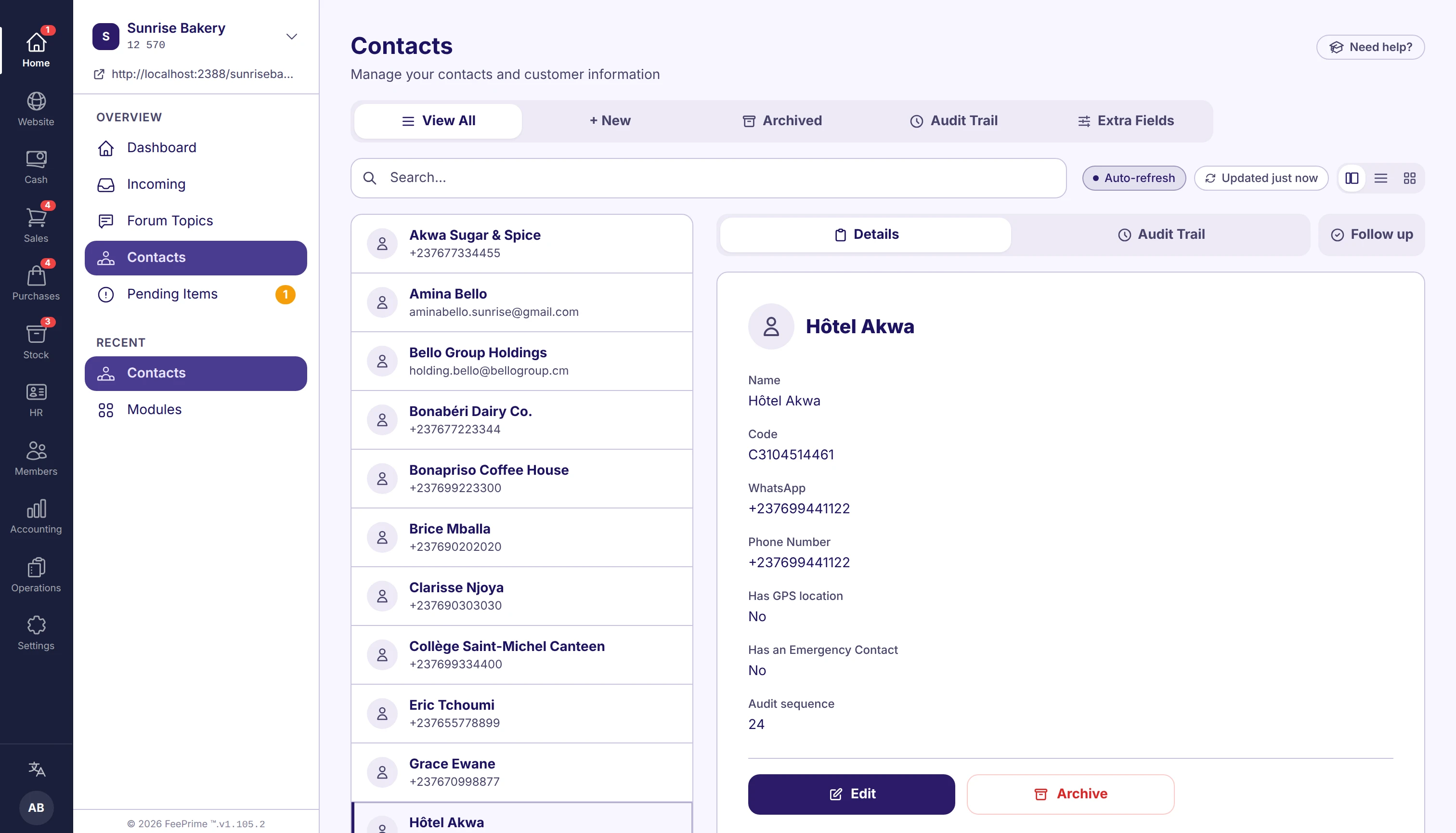 contacts screen in FeePrime (Sunrise Bakery).
2. You do not have to climb every rung
The chain exists so each step can carry forward what the previous step agreed — not so you must fill out five screens for every loaf of bread.
How many steps you use depends on how the customer buys:
- Walk-in counter sale: A customer walks into Sunrise Bakery’s Bonapriso shop, picks two loaves and a juice for 3,500 XAF, and pays Paul at the counter. Go straight to an Invoice and Payment (or your Till). No quote, no sales order.
- Service or catering job: Nadège Fouda asks for a quote on a 350,000 XAF anniversary pastry table. She agrees, you deliver the event, and you convert the Quote straight into an Invoice.
- Wholesale, credit, or scheduled delivery: Hôtel Akwa orders weekly stock that has to be baked, checked, and delivered by rider. Here, Order → Sales Order → Invoice keeps sales, baking, and dispatch aligned.
One small shop, cash over the counter, no deliveries? Start straight at Invoices. Leave Quotes and Sales Orders unused — nothing breaks, and they will be waiting if your business grows into wholesale later.
3. Why physical goods invoice last (and hold payment as an advance)
There is one crucial twist in the chain above, and in FeePrime it is the default behaviour, not an extra setting you have to turn on.
An invoice must not change. An order changes right up to dispatch.
Think about what really happens at 5:00 AM in a busy shop. Hôtel Akwa paid 180,000 XAF upfront on Thursday for 400 croissants. On Saturday morning, one tray burns in the oven, so Junior can only leave with 360 croissants. Or a storekeeper swaps one flour brand for another after checking with the buyer.
If you had already issued the invoice on Thursday when the cash arrived, that invoice would now be legally wrong. You cannot simply type over a finalised invoice — your only clean fix would be issuing a credit note or voiding it and raising a new one.
So for physical goods, FeePrime puts the invoice last:
   ORDER  ──> Customer pays upfront ──> Money is held as an ADVANCE
     |                                  against the order
     v
   Goods are fulfilled (quantities or lines may still change)
     |                                  e.g. 360 croissants actually ship
     v
   INVOICE raised last, strictly for what actually went out
     |                                  (360 croissants, not 400)
     v
   The ADVANCE is applied automatically — no second payment needed
The customer’s money is safely recorded the moment it arrives. Your team stays free to handle real-world shortages or substitutions before dispatch. And your accounts only ever receive one clean, accurate invoice matching what actually left the building.
4. The exception: items delivered by the invoice itself
Not everything sits on a shelf waiting for a motorbike. Some items are delivered by the invoice itself:
- A membership starts the moment its invoice is paid.
- An event ticket is minted when the invoice is approved.
- A credit or digital top-up lands on the customer’s balance as soon as the invoice settles.
If FeePrime held back the invoice on those items, the customer would pay and still not receive what they bought. For those items, FeePrime raises the invoice right at payment, just as you would expect.
An organisation can choose to opt out and invoice at payment for everything, but leaving deferred invoicing on for physical goods saves most shops from messy corrections later.
5. Why not just write an invoice for everything?
Busy owners often ask why they should bother with Quotes, Orders, or Sales Orders at all. The answer is simple: collapsing documents loses the answers you need when something goes wrong.
- Without a Quote, you cannot prove what price you offered Nadège Fouda or that the offer expired last Tuesday.
- Without an Order, you cannot see how much confirmed business is waiting to be delivered this week.
- Without a Sales Order, your kitchen or warehouse has no clean pick list showing what to prepare and from which location.
- An Invoice only answers one question: what is legally due? Both your books and your customer’s books key off it.
Do not treat an unaccepted quote as a confirmed order, and do not use a draft invoice as a packing list.
6. The one rule that saves hours later: link, never retype
If you remember only one habit from this lesson, make it this:
Documents point at each other rather than copying each other.
An invoice knows which sales order and customer order it came from. A sales order knows its quote. When Hôtel Akwa’s accountant calls three weeks later asking why Invoice #412 was 18,000 XAF lower than their deposit, Amina can click straight back from the invoice to the fulfilled order and answer in ten seconds.
Never retype figures into a fresh document. If Paul opens a blank invoice and types the same 360 croissants and 19.25% TVA by hand instead of creating the invoice from the existing order, the numbers look identical — but the link is silently broken. Nothing on the screen will flash a warning, yet your order stays open as if it was never billed, and the audit trail disappears.
Never try to fix a packing mistake by editing a finalised invoice. Wait until goods ship to raise the invoice, and if a mistake slips through afterwards, use a proper Credit Note (Sales / Selling / Credit Notes) instead.
Try it
Open staging.feeprime.com — a practice copy of FeePrime, kept apart from the real thing — and spend five minutes exploring the four lists:
- Sign in and expand Sales / Selling in the left sidebar.
- Open Quotes and notice how the list page layout looks familiar — you already know how to search and filter here.
- Open Orders and click any existing record to see its customer, lines, and linked documents.
- Open Sales Orders and check which location or warehouse is set to fulfil the items.
- Open Invoices and click into one record to trace which order it came from without creating or editing anything yet.
You do not need to memorise every button today — once you recognise what each of the four documents means, every screen in this course falls straight into place.