
How EUDR Traceability works in FeePrime — from Cooperative Portal to EU TRACES NT
What FeePrime EUDR Traceability & Cooperatives does: It connects partner cooperatives, smallholder farmers, GPS-mapped farm plots, warehouse cocoa/coffee lots, processing runs, and one-click EU TRACES NT GeoJSON filings into one unbroken chain of custody. Instead of chasing disconnected spreadsheets and KML files before every shipment leaves Douala port, cooperatives onboard growers through your Supply-Chain Portal, field agents map
<4 hapins and≥4 hapolygons on mobile, warehouse intake links every lot to its exact origin plots, and every export batch downloads a strictly consignment-scoped GeoJSON file ready for European buyers.
Before you start, sign in and open Traceability / Farmers and Traceability / Farm Plots.
Can’t find it? It may be turned off for your business, or your account may not be allowed to open it. Ask the person who set up your FeePrime. They can fix both.
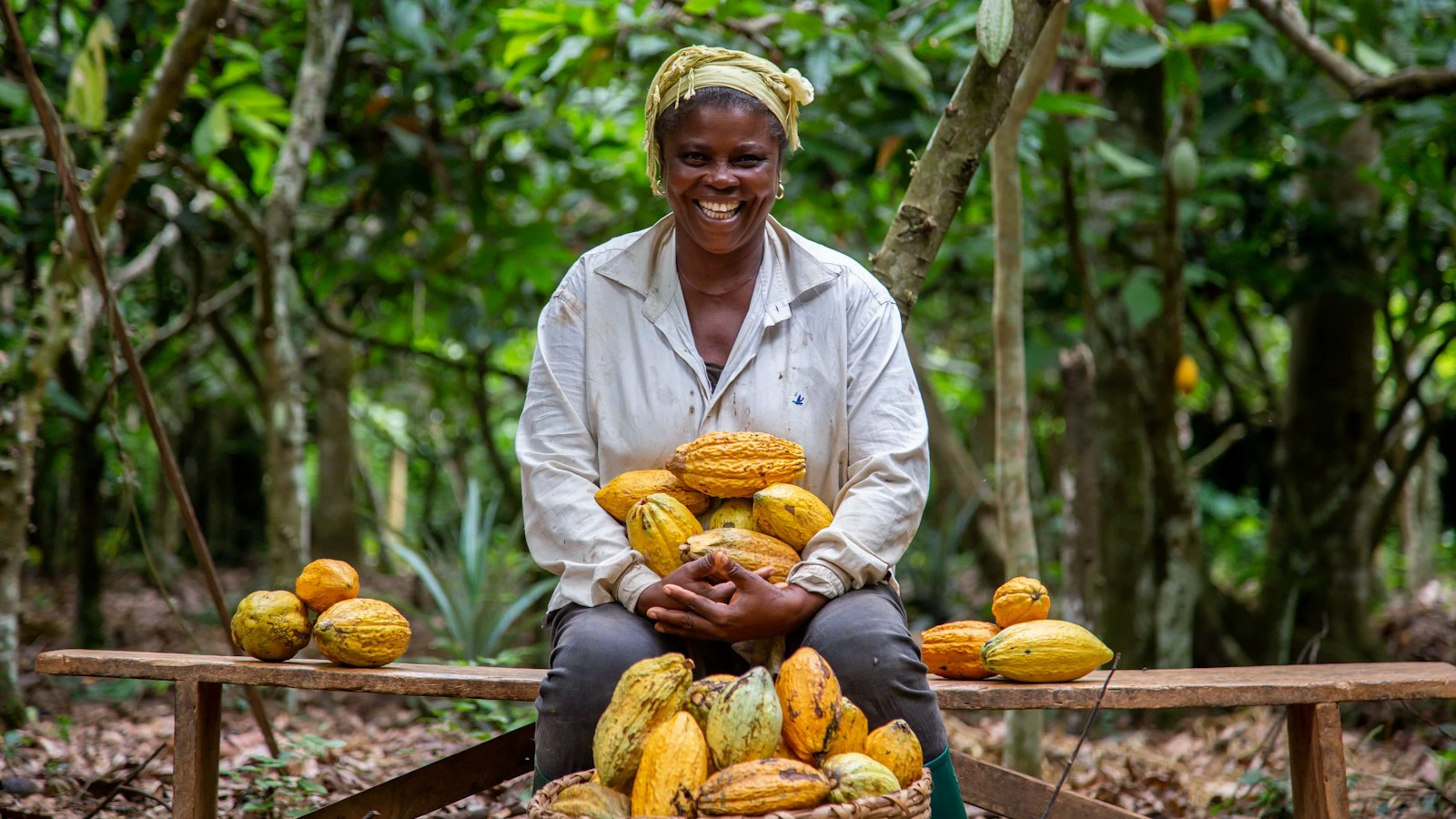
Photo: Tobias Nii Kwatei Quartey on Unsplash
Every cocoa season in Douala, Alleluia Cocoa ships containers of dried beans to European buyers. Under the European Union Deforestation Regulation (EUDR), a paper certificate and a cooperative stamp are no longer enough. Before a container clears port in Europe, the importer must file a Due Diligence Statement in EU TRACES NT proving that every kilo in that shipment came from land that was not deforested after December 31, 2020 — backed by exact GPS coordinates for every farm plot.
If you export cocoa, coffee, palm oil, rubber, soy, timber, or cattle, that proof starts long before the container is sealed. When Elise Njoya, Alleluia Cocoa’s Traceability Manager, works with SCOOP Cacaoculteurs de la Lekié in Obala and Monatélé, she needs one unbroken chain connecting cooperative coordinator Jean Mvondo, smallholder growers Joseph Essomba (6.53 ha in Obala) and Pauline Mvogo (2.4 ha in Monatélé), the wet cocoa received at the buying station, the dried beans leaving the fermentation plant, and the final GeoJSON file sent to the buyer.
FeePrime holds that entire chain in one place — no stitched spreadsheets, no lost KML files, and no guessing which farmer’s beans went into which export bag. (For day-to-day store grading, warehousing, and general sales shipping, see FeePrime for an agricultural business.)
1. The six-link chain from farm plot to EU TRACES NT
Traceability in FeePrime is enabled for licensed exporters and agribusinesses through a dedicated traceability grant. Turning it on unlocks Traceability / Farmers and Traceability / Farm Plots, and automatically configures your Supply-Chain Portal for cooperatives (“Join our supply chain” — never generic e-commerce “Sell”).
Here is how one export shipment moves through FeePrime from village to port:
1. Cooperative Portal (/portal/:slug)
   SCOOP Lekié applies -> Elise approves -> cooperative joins supply chain
        |
        v
2. Farmers (Traceability / Farmers)
   Jean adds or bulk-imports Joseph Essomba, Pauline Mvogo & fellow growers
        |
        v
3. Farm Plots (Traceability / Farm Plots & Satellite Map)
   Pauline: 2.4 ha GPS pin (< 4 ha) | Joseph: 6.53 ha walked polygon (>= 4 ha)
   Verdict verified: Deforestation-free (emerald green marker)
        |
        v
4. Plot-linked intake (Inventory / Movements / Goods Receipts)
   500 kg wet cocoa -> lot COC-EUDR-2026-041 tagged with Joseph & Pauline's plots
        |
        v
5. Processing lineage (Inventory / Production / Production Runs)
   INPUTS: COC-EUDR-2026-041 (500 kg wet) -> OUTPUTS: EXP-EUDR-2026-019 (200 kg dried)
        |
        v
6. Export filing (Inventory / Reports / Lot Reports)
   Traceability Lot Report -> Download GeoJSON (EUDR) -> EU TRACES NT
Each step builds directly on the one before it. If you keep every link clean as the beans move, the final export file takes one click instead of three weeks of chasing paper notebooks.
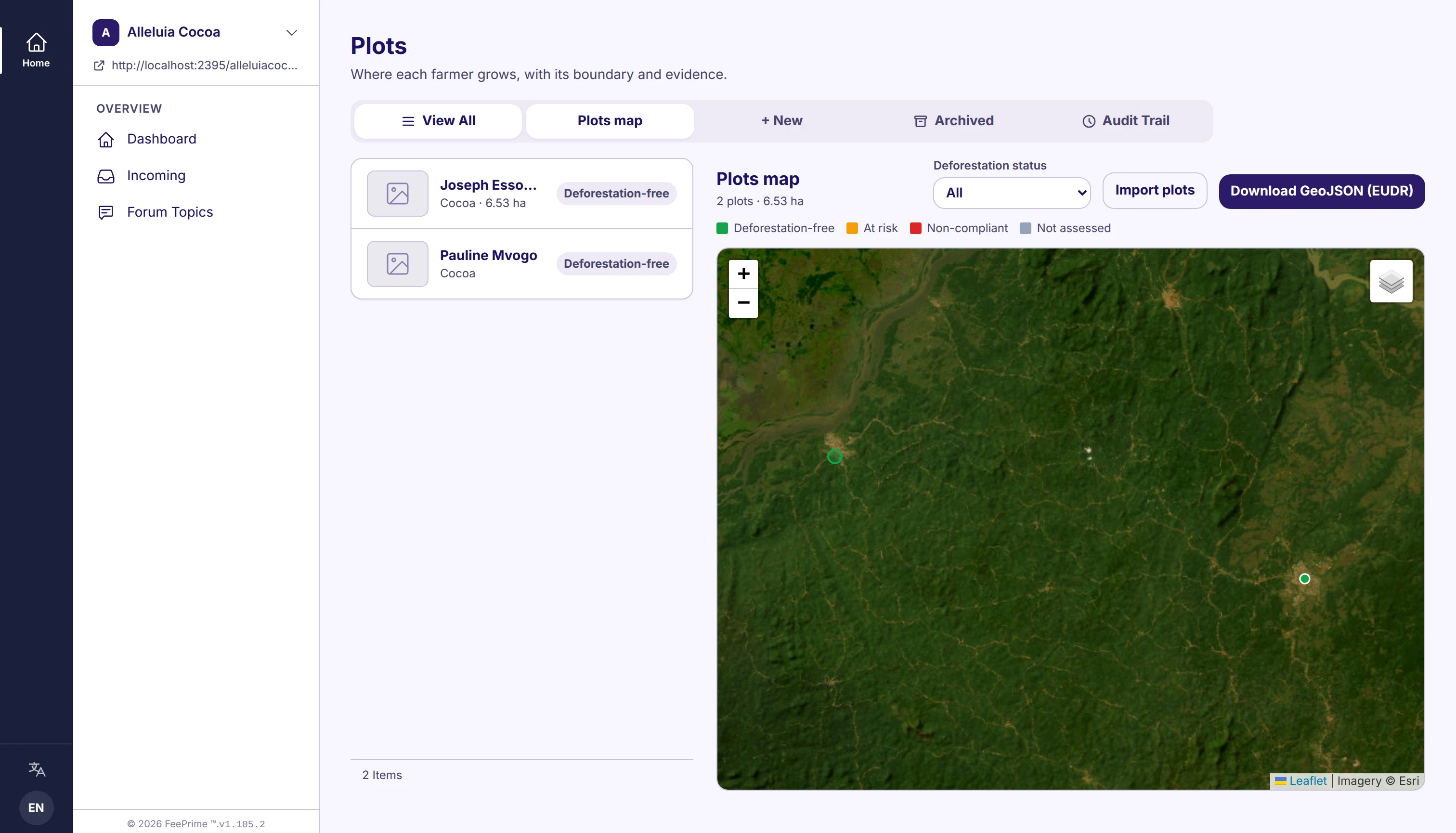 Alleluia Cocoa satellite Farm Plots map in Cameroon displaying Deforestation-free GPS pins (<4 ha) and walked farm polygons (≥4 ha) from Lekié cooperatives.
2. How cooperatives and farmers enter the chain
Alleluia Cocoa publishes its Supply-Chain Portal at /portal/alleluiacocoa. When Jean Mvondo visits that link, he clicks Register as a cooperative or farmer and follows Join our supply chain, entering SCOOP Lekié’s details along with its first farmer and plot on a single page.
Approval protects your data from day one. An unapproved cooperative cannot publish live farmer or plot records and cannot see any other cooperative’s growers. Once Elise reviews and approves SCOOP Lekié, Jean maintains his own farmer roster directly in the portal. Individual farmers do not sit stuck in a manual approval queue — because compliance risk lives on the plot evidence, not on a farmer’s name — while every addition still lands in FeePrime’s audit trail.
- Small cooperative (15–40 growers)? Add farmers one by one in the portal or under Traceability / Farmers.
- Large cooperative (500–4,000 growers)? Open Import farmers in Traceability / Farmers and upload a CSV or Excel sheet. FeePrime automatically matches columns for full name, phone, village, national ID, and cooperative, and previews every row before saving.
Open any farmer’s record and you see their cooperative, village, phone, ID, a live PLOTS panel, and a + Add plot shortcut right on the same screen. Both Farmers and Farm Plots work offline on mobile devices, so field officers in Obala or Monatélé can capture records without a steady signal.
3. Mapping farm plots: the 4-hectare rule and four verdicts
EUDR draws a hard line at 4 hectares, and FeePrime enforces it directly on the New plot screen:
- Under 4 hectares (< 4 ha): A single GPS pin is enough. In Monatélé, Jean’s field officer stands in Pauline Mvogo’s 2.4 ha plot and taps Drop pin at my GPS.
- 4 hectares and above (>= 4 ha): A closed multi-vertex polygon is mandatory. At Joseph Essomba’s 6.53 ha farm in Obala, the officer taps Walk boundary and walks the perimeter — or imports a verified GeoJSON/CSV boundary file.
FeePrime calculates the plot’s area directly from the GPS geometry instead of letting anyone type a guess. The hectares shown on your export declaration will always match the exact shape on the map.
Never map a farm of 4 hectares or more with a single GPS pin. European customs portals reject point-only filings for plots at or above 4 ha, and typing a fake smaller area is impossible once the boundary is measured.
To review every mapped farm at once, open the interactive Satellite Farm Plots Map (/farm_plots/map). Every pin and polygon shows its producer details and one of four deforestation verdicts:
- Deforestation-free — cleared for EUDR export (emerald green map marker).
- Under review — satellite or field check is still in progress.
- Flagged — tree-cover loss or boundary conflict detected; do not ship to the EU.
- Not assessed — coordinates captured, but deforestation review has not started.
Never treat a “Not assessed” or “Under review” plot as cleared for EU export. Keep beans from those farms separate until their verdict changes to Deforestation-free.
4. Keeping origin attached from buying station to dried export bag
A verified map means nothing if the warehouse loses track of which sacks came from which farms. FeePrime keeps physical stock tied to origin plots in two everyday moves:
- Plot-linked inbound intake: Under Inventory / Movements / Goods Receipts (or Inventory / Movements / Inventory Transactions), the Obala storekeeper receives 500 kg of wet cocoa from Joseph and Pauline into lot
COC-EUDR-2026-041and tags their exact origin plots on that delivery. - Multi-stage processing lineage: When Alleluia Cocoa ferments and dries 500 kg of wet cocoa (
COC-EUDR-2026-041) into 200 kg of export-grade dried beans (EXP-EUDR-2026-019) under Inventory / Production / Production Runs, FeePrime automatically carries the upstream link forward. Open the finished run and you see the consumed INPUTS lot badge right next to the finished OUTPUTS export lot — no manual re-tagging.
Never mix tagged EUDR cocoa and untagged roadside cocoa into the same lot. If a buying clerk buys 80 kg of unmapped spot beans, receive them into a separate non-EUDR lot. Mixing even a few unverified bags into a traceable lot breaks the proof for the entire container.
5. Pulling your Lot Traceability Report and EU TRACES NT GeoJSON
When EXP-EUDR-2026-019 is bagged and ready for the Douala port, Elise opens Inventory / Reports / Lot Reports and creates a new Lot report:
- Set report type to Traceability.
- Pick the dried cocoa inventory item and enter export lot reference
EXP-EUDR-2026-019.
FeePrime walks backward through the full history and displays MADE FROM (UPSTREAM) -> COC-EUDR-2026-041 -> the inbound receipt -> ORIGIN PLOTS & FARMERS, listing Joseph Essomba’s 6.53 ha polygon and Pauline Mvogo’s 2.4 ha pin.
From that report, Elise clicks Download GeoJSON (EUDR). FeePrime generates a clean application/geo+json file ready for EU TRACES NT:
- Strictly a standard
FeatureCollectionwith onlytypeandfeaturesat the top level. - Closed polygon rings,
ProducerName,Area, and a guaranteed ISO-2ProducerCountrycode (CMfor Cameroon). - Strictly scoped to that consignment — it never leaks plots from other cooperatives or unrelated containers.
Never export your organisation’s entire plot list for a single shipment. FeePrime protects you from accidental false filings too: if someone clicks Download GeoJSON (EUDR) on an old lot with no tagged origin plots, FeePrime returns 0 features rather than guessing or dumping unrelated farms.
Try it
Open staging.feeprime.com — a practice copy of FeePrime, kept apart from the real thing — and trace a sample export batch in five minutes:
- Open Traceability / Farmers and inspect a farmer record to see the live PLOTS panel and
+ Add plotbutton. - Open Traceability / Farm Plots and switch to the Satellite Farm Plots Map to check the color-coded deforestation verdicts across pins (< 4 ha) and polygons (>= 4 ha).
- Open Inventory / Production / Production Runs and view a finished fermentation or drying run to see its INPUTS lot badge alongside its OUTPUTS export batch.
- Open Inventory / Reports / Lot Reports, create a Traceability report for a dried export lot, and follow MADE FROM (UPSTREAM) down to ORIGIN PLOTS & FARMERS.
- Click
Download GeoJSON (EUDR)and open the downloaded file to verify that only that batch’s plots appear withProducerName,Area, andProducerCountry.
Once you see that six-link chain work end to end, the next six lessons will walk you through setting up each link for your own cooperatives and warehouses.