
Founders: Applying once and writing a pitch investors trust
Before you start, sign in to your Dealroom portal and open My Pitches (or your Founder Profile if you have not applied yet).
Can’t find it? Your dealroom may not have turned on founder applications yet, or your account may not have portal access. Ask your dealroom curator (the person who set up your FeePrime portal). They can fix both.

Raising capital in Douala usually starts the same exhausting way. Clarisse, the founder of KokoFresh, sends her 28-page PDF pitch deck on WhatsApp to three contacts. Within a week, someone forwards it to a competitor. Worse, serious investors like Dr. Samuel—who leads Mungo Angels and writes 15,000,000 to 50,000,000 FCFA checks—rarely read bloated PDFs on their phone between meetings.
Wouri Ventures flips that experience on its head. You apply once as a founder, prove who you are, and then write a crisp, structured pitch directly inside FeePrime. Browsing investors only see your headline facts and your Problem statement. Your real edge—your solution, margins, traction, and use of funds—stays locked until an investor requests an intro and you personally say yes.
1. Apply once as a founder (and why Cédric checks you first)
Before you can publish a pitch on Wouri Ventures, you need an approved Founder Profile. FeePrime uses the same vendor foundation across its portals, set to the dealroom vertical—which means your application form stays clean and focused.
You will not see shop opening hours, delivery fees, or pickup addresses cluttering your founder form. You only fill in your real identity and venture basics: trading name, logo, short bio, city, phone number, email, and any identity or company documents Wouri Ventures requires.
When you click submit, your profile lands in Cédric’s review queue (under Portal Marketplace / Vendors / Portal Vendors on the curator side). Every founder profile waits for a real person to check it—because one fake founder with a borrowed phone number can ruin trust across the whole dealroom.
Here is the good news: you are only vetted once.
- While your profile is still pending, FeePrime blocks you from publishing a pitch.
- The moment Cédric approves your founder profile, the door opens. Every pitch you create—and every update you make to your traction or round size later—goes live immediately as written, with zero waiting for curator re-approval.
- You cannot self-archive your founder profile. If you ever step away from the dealroom permanently, ask Cédric to archive your profile from the staff side so active intro threads do not break mid-raise.
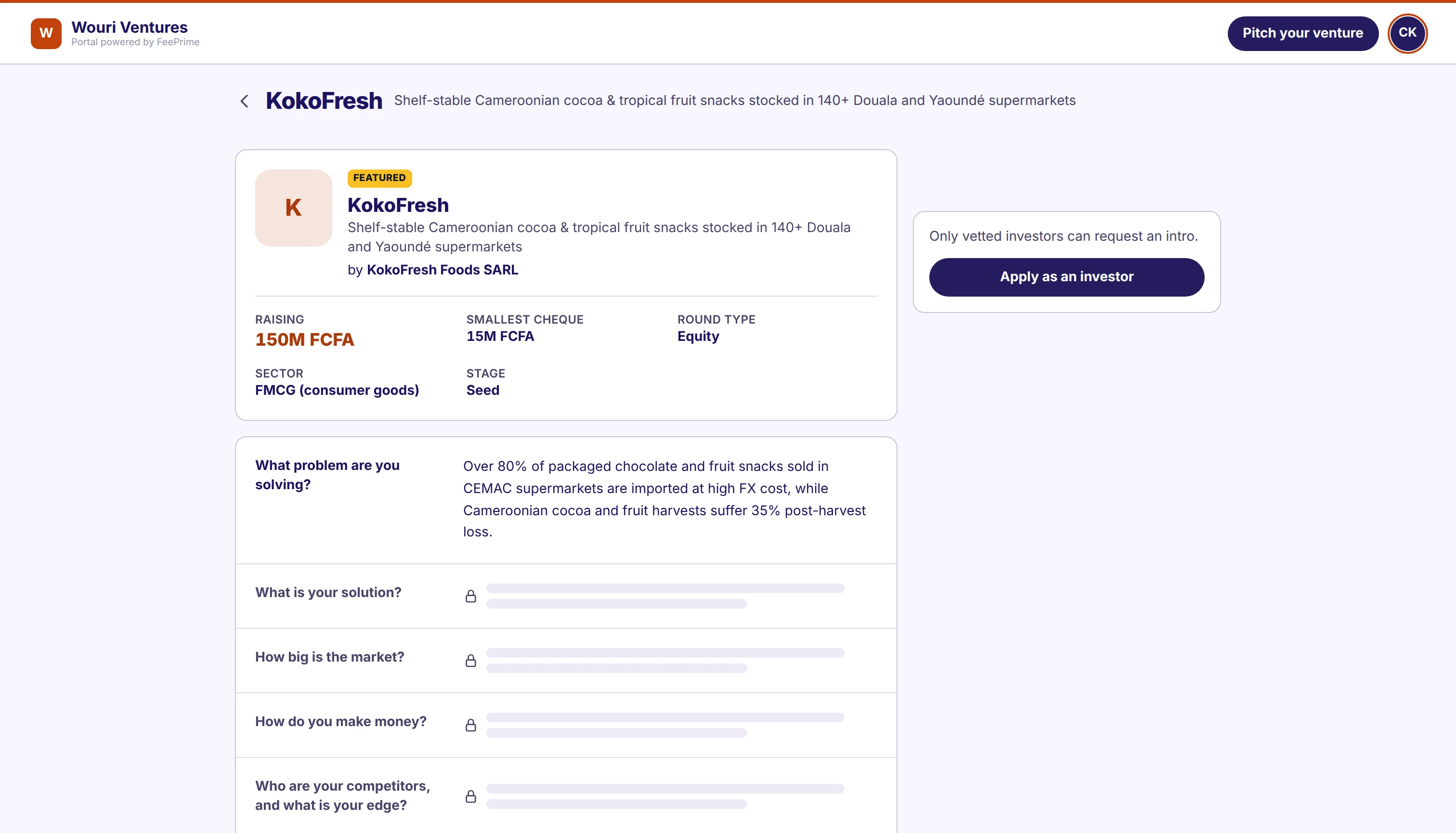 Structured written-only pitch card for KokoFresh showing sector, stage, raise target, and problem teaser.
2. How a Dealroom pitch splits public teaser from private substance
Think of your pitch under My Pitches as a two-room house. Every vetted investor on Wouri Ventures can stand on the porch and read the teaser. Only investors whose intro request you approve get the key to the inside.
[1. Apply Once]               [2. Publish Pitch]                [3. Intro Accepted]
Founder Profile               My Pitches (Live)                 Full Pitch Unlocked
(vertical: dealroom)          ─────────────────                 ───────────────────
       │                      PUBLIC TEASER                     PRIVATE SUBSTANCE
       ▼                      • Venture Name & Logo             • Solution
Cédric approves once   ───▶   • One-Liner, Sector, Stage  ───▶  • Market Size
(No re-approval on            • City, Round Type & Status       • Business Model
 later pitch edits)           • Amount Raising & Min Ticket     • Competition
                              • Problem (your hook)             • Team & Traction
                                                                • Why Now & Use of Funds
Why does this matter? Because Clarisse can put KokoFresh in front of 40 vetted local and diaspora angels without handing her supplier pricing or factory unit economics to strangers. At the same time, Dr. Samuel sees enough concrete facts in 30 seconds to know whether KokoFresh fits Mungo Angels’ ticket size and sector.
3. Fill in the headline facts and upload your logo
Open My Pitches and create a new pitch. Start at the top with the structured facts that power investor browsing and filtering:
- Venture Name: The name of the company raising money (for example, KokoFresh).
- One-Liner: One plain sentence saying what you build and for whom (“Shelf-stable cold-pressed cocoa and fruit snacks processed from smallholder farms across Littoral”).
- Logo: Optional, and the only file upload a pitch carries. FeePrime Dealroom is deliberately written-only—there is no PDF deck uploader, no Excel attachment box, and no external data room slot. Everything an investor reads lives cleanly in the form.
- Sector & Stage: Pick the closest match (Clarisse picks FMCG / Agri-processing and Seed).
- City: Where your core operations run (for example, Douala).
- Round Type: Choose one of the four real instrument types: Equity, Convertible, Debt, or Grant.
- Amount Raising, Min Ticket & Currency: Clarisse enters 150,000,000, sets Min Ticket to 15,000,000, and selects XAF (FCFA).
Common mistake — Don’t leave Min Ticket blank if you cannot manage 50 tiny checks. Setting 15,000,000 FCFA tells Dr. Samuel right away that KokoFresh fits his 15M–50M FCFA sweet spot while politely filtering out 500,000 FCFA curiosity requests.
Common mistake — Never paste a Google Drive, Dropbox, or Notion link to a deck inside your public fields. That bypasses FeePrime’s privacy gate and hands your confidential numbers to anyone browsing the directory.
4. Write a Problem teaser that attracts Dr. Samuel without giving away your secret sauce
Your Problem field is required and publicly visible in the teaser. Its only job is to make the right investor think, “That is a real, expensive problem in Cameroon—I want to see how this team solves it.”
Compare how two founders write the exact same field:
- Weak Problem (too vague, zero credibility): “Cameroon has great cocoa and fruit, and people want healthier snacks. We have an amazing solution that will disrupt Africa.”
- Dangerous Problem (leaks the private pitch): “Our cold-press line cuts spoilage to 4%, giving us a 46% gross margin at 1,200 FCFA per pouch across 14 Carrefour and Super U stores.”
- Sharp Problem (attracts serious intros): “Over 35% of smallholder fruit and cocoa-pulp harvests in Littoral spoil before reaching Douala supermarkets because local processors lack affordable cold-chain preservation. Urban families spend over 12 billion FCFA a year on imported packaged snacks priced 2× higher than local produce.”
Never write your Solution, supplier names, or gross margins inside the Problem box. Save the proof for the locked rooms below.
5. Complete the 8 confidential sections investors actually read
Once Clarisse accepts Dr. Samuel’s intro request, FeePrime unlocks the rest of her pitch. Write these eight sections in plain, direct numbers—no buzzwords, no filler:
- Solution (required) — What KokoFresh actually makes or delivers, and why customers buy it twice.
- Market Size (optional) — Count real buyers and realistic annual spend in Cameroon or CEMAC, not a global $100 billion number.
- Business Model (optional) — How you price, who pays, what it costs you to produce one unit, and your gross margin.
- Competition (optional) — Name the real alternatives customers use today (including imported brands or informal stalls) and why you win.
- Team (required) — Who runs operations, sales, and finance today, and what hard proof shows they can execute.
- Traction — Monthly revenue, active retail doors, repeat order rate, or signed purchase orders. Real small numbers beat vague promises.
- Why Now — What changed in regulation, costs, distribution, or buyer habits that makes 2026 the right moment.
- Use of Funds — Break the 150,000,000 FCFA into clear buckets (for example: 65M FCFA processing line, 45M FCFA working capital for harvest inventory, 40M FCFA Douala and Yaoundé retail distribution).
Running a second venture later? Never overwrite an old pitch to launch a new company. One approved founder profile can hold multiple pitches—one pitch per venture. Keep KokoFresh intact and simply add a new pitch under My Pitches for the second business.
6. Control visibility with Round Status and Access Membership Types
At the bottom of your pitch setup, two controls decide who can see your listing and whether new intros can come in:
- Round Status:
- Open: Your teaser is listed in the dealroom and accepting intro requests.
- Paused: Your pitch is hidden from browse while staying safely saved under My Pitches. Use Paused when you are still drafting, waiting on audited numbers, or taking a short break from calls.
- Closed: Your pitch stays visible with a Raised badge so the community sees your win, and FeePrime blocks any new intro requests.
- Access Membership Types: Some dealrooms split investors into membership tiers (such as Founding Angels vs. General Members) so only specific pass holders can see certain raises. Your dealroom has one open investor pool? Leave Access Membership Types blank. Nothing breaks.
Archive, never delete—and don’t archive a closed raise just to stop intros. Setting Round Status to Closed stops new requests while giving KokoFresh public social proof with the Raised badge. Only archive a pitch if you cancel the raise completely.
Try it
You can practise this entire founder workflow safely on staging.feeprime.com—a practice copy of FeePrime, kept apart from the real thing.
- Sign in to the staging Dealroom portal and review your Founder Profile—notice there are zero shop delivery or opening-hours fields.
- Open My Pitches and start a practice pitch for KokoFresh (Seed, Equity, 150,000,000 FCFA, Min Ticket 15,000,000).
- Upload a square brand Logo—and confirm you do not need any PDF deck attachment.
- Write a crisp 3-sentence Problem teaser without mentioning your product margins, then fill in Solution, Team, Traction, and Use of Funds.
- Save the pitch with Round Status set to Paused, read it back on your phone screen, and switch it to Open only when every number holds up.
Take 20 quiet minutes to write clean, honest numbers once—and every serious investor conversation that follows will start three steps ahead.