
Founders: Handling intro requests, unlocking your pitch and messaging investors
Before you start, sign in to your Dealroom portal and open Founders / Intros (and Founders / Investors for proactive outreach).
Can’t find them? Your founder profile or pitch may still be waiting for curator approval, or you may be signed in with a non-founder account. Ask the dealroom team who set up your portal — they can check both.

Photo: Vitaly Gariev on Unsplash
Raising money usually goes wrong in one of two ways. Either you blast your full pitch deck across WhatsApp groups and lose track of who has your margins and customer list, or you guard everything so tightly that serious investors never get past a vague one-paragraph blurb.
At Wouri Ventures in Douala, Clarisse is raising 150,000,000 FCFA at the Seed stage for KokoFresh, her FMCG and agri-processing venture. Because her public teaser only shows the high-level story, no investor sees her full financials, deck, or unit economics until she says yes. Every introduction is double opt-in: an investor asks first, Clarisse checks who they are, and she chooses whether to open the door.
This lesson shows you how to evaluate incoming intro requests, unlock your full pitch for the right people, say no cleanly without awkward follow-up spam, and reach out to vetted investors yourself.
1. How an intro request moves from teaser to chat
Only investors vetted by a curator like Cédric can request an introduction on the dealroom. Unvetted visitors see teasers, never your private numbers and never your inbox.
Here is how a single intro moves once your pitch is live:
Your Teaser is Live
        |
        v
Vetted Investor clicks "Request Intro" (adds a short note)
  [Status: Requested]
        |
        v
You open Founders / Intros and inspect their full Investor Profile
        |
        +--- Click ACCEPT ----------------------------+
        |     [Status: Accepted]                      |
        |     -> Full pitch unlocks for THAT investor |
        |     -> Direct chat opens automatically      |
        |
        +--- Click DECLINE ---------------------------+
              [Status: Declined]                      |
              -> Full pitch stays locked              |
              -> Pick structured reason + short note  |
              -> 30-day cooldown starts for this pitch
Notice two protections built into this flow. First, accepting one investor never exposes your full pitch to anyone else. Second, every intro request has its own intro number and status history, so neither you nor the dealroom curator loses track of where a conversation stands.
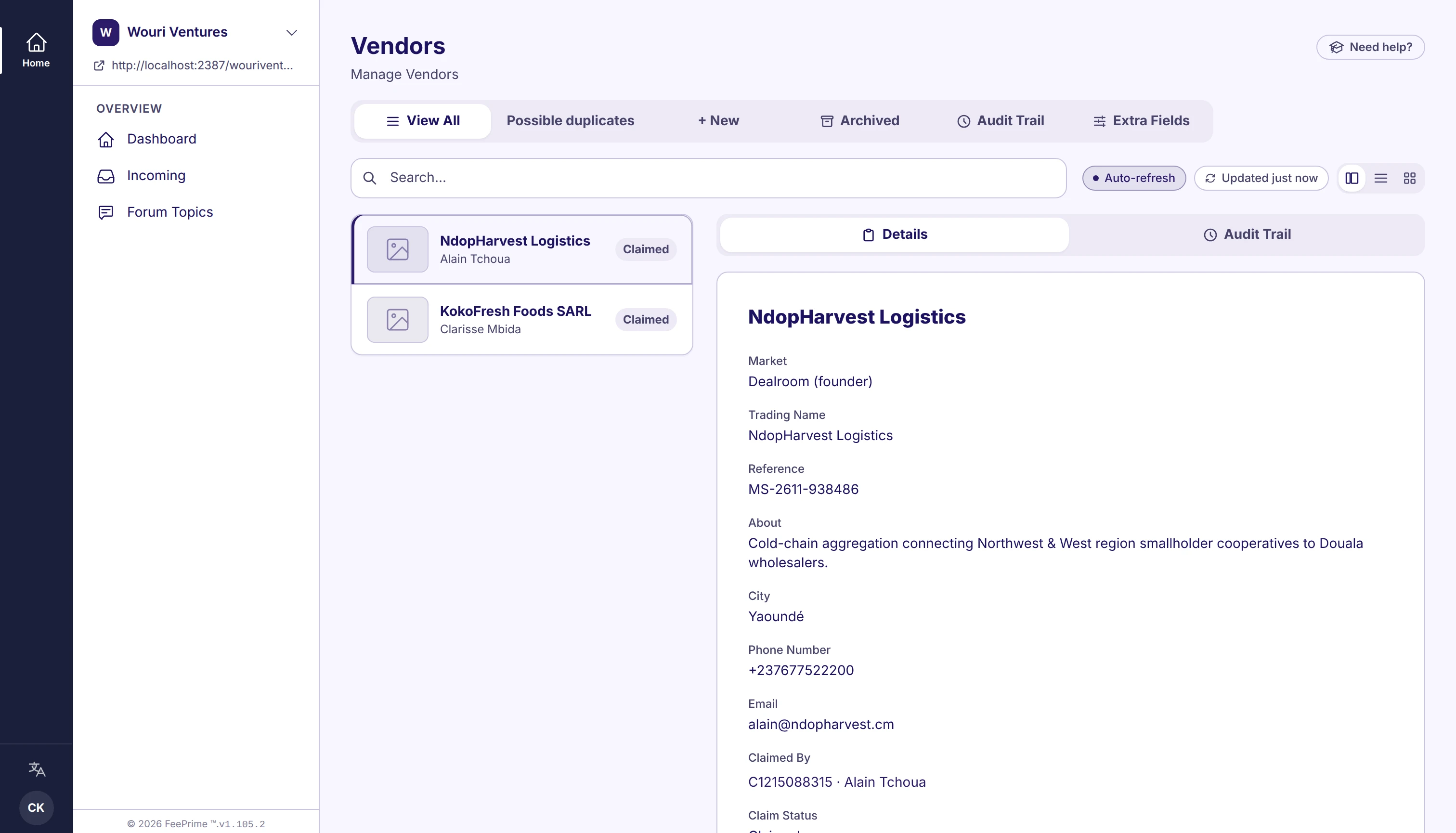 Vetted founders (KokoFresh Foods SARL & NdopHarvest Logistics) under Portal Vendors — vetted once, ready to review investor intros and browse vetted investors.
2. Read the investor profile before you decide
On Tuesday morning, Clarisse gets a notification: Dr. Samuel has requested an introduction to KokoFresh. Instead of rushing to click Accept, she opens the request under Founders / Intros and checks his full vetted investor profile right beside his note.
Every vetted investor profile gives you seven concrete facts to weigh:
- Investor type: Whether the person invests as an Angel, VC fund, Corporate, or Family office.
- Fund name: The syndicate, firm, or holding vehicle they represent — for Dr. Samuel, that is Mungo Angels.
- Ticket range and currency: Their typical minimum and maximum check size (for example, 15,000,000 to 50,000,000 FCFA).
- Target sectors: The industries they actively back, such as agri-processing, FMCG, or logistics.
- Target stages: Whether they write checks at Pre-seed, Seed, or later growth stages.
- About: A plain summary of how they work with founders, what geography they cover, and what they look for.
- Intro note: The personal message they wrote specifically about your venture.
Dr. Samuel’s profile lines up on every count: Mungo Angels writes 15M–50M FCFA Seed checks in Cameroonian consumer and food businesses, and his note mentions KokoFresh’s distribution across Douala supermarkets. That is a high-signal match.
Never accept an intro without checking the ticket range and target stage first. A friendly note from a late-stage fund that only writes 2,000,000,000 FCFA checks will drain hours of your week and still end in “come back in three years.”
3. Accepting an intro: instant pitch unlock and direct chat
Once Clarisse clicks Accept on Dr. Samuel’s request, three things happen in one second:
- The intro status moves from Requested to Accepted.
- KokoFresh’s full pitch unlocks for Dr. Samuel alone — he can now read the detailed financials, traction breakdown, use of funds, and full materials Clarisse submitted. Every other investor on Wouri Ventures still sees only the public teaser.
- A direct chat thread opens automatically between Clarisse and Dr. Samuel, seeded with the intro details so neither side has to start from a blank screen.
Use that first message well. Thank the investor briefly, point them to the one metric or section of your full pitch that answers their intro note, and propose two concrete times for a 20-minute call.
Never move the conversation off-platform by forwarding your raw deck into unvetted group chats. Keeping the pitch unlock and early messages inside the dealroom means you always know exactly who saw your numbers and when.
4. Declining cleanly, structured reasons, and the 30-day cooldown
Saying no quickly is a sign of a disciplined founder, not rudeness. Later that afternoon, Clarisse receives a second intro request from a corporate investor whose profile focuses strictly on Series B logistics across West Africa. KokoFresh is a Seed food brand in Cameroon — wrong stage and wrong fit.
When Clarisse clicks Decline, FeePrime asks her to choose one of four structured reasons:
- Not a profile fit — the investor’s sector, geography, or thesis does not match your venture.
- Round full — you already have commitments covering your target raise.
- Wrong stage — the investor writes much earlier or much later checks than your current round.
- Other — any situation that does not fit the three options above.
She can also add a short decline note — one calm sentence like “Thank you for reaching out — we are raising a Seed round in Cameroon FMCG and will gladly reconnect when we expand into regional logistics.” That note stays visible on the intro record, keeps bridges intact, and helps Cédric understand dealroom match quality.
What the 30-day cooldown does: The moment you decline a request, FeePrime starts an automatic 30-day cooldown for that investor on that pitch. They cannot hammer your inbox with a duplicate request the next morning. If your round or stage changes a month later, the door is not slammed shut forever.
You may also see two other statuses in your intro list:
- Withdrawn: The investor cancelled their own request before you answered. No action needed.
- Expired: The request sat open past the response window without a reply.
Never leave intro requests sitting unanswered until they expire. Curators monitor intro response health across the dealroom, and slow replies hurt your chances of being featured. Reviewing requests twice a week takes five minutes and signals that you run a tight business.
5. Finding and messaging vetted investors yourself
You do not have to sit still waiting for inbound requests. Once your founder profile is vetted, open Founders / Investors to browse the directory of vetted investors on Wouri Ventures.
Every card shows the investor’s type, fund name, ticket range, target sectors, target stages, and bio. Use those details to build a shortlist before you write a single message:
- Raising a first small angel check (5M–25M FCFA)? Focus on Angels and local syndicates whose ticket minimum matches your ask. You do not need to pitch 30 institutional funds — five well-matched angels are far more valuable.
- Running a full Seed round (100M–300M FCFA) with a lead investor? Shortlist VC funds, Family offices, and Angels who co-invest alongside a lead like Mungo Angels, and message them in small waves of five to eight so you can keep up with follow-up calls.
When you message an investor from Founders / Investors, write three short sentences: who you are and what your business sells, why their stated sector and ticket range fit your round, and a clear invitation to view your teaser or request an intro.
Never copy-paste the exact same cold message to every investor in the directory. Investors compare notes and curators see spam complaints quickly. Five tailored messages beat fifty generic blasts every time.
Try it
Practice the full founder workflow on staging.feeprime.com — a practice copy of FeePrime, kept apart from the real thing, where you can click freely without messaging real investors.
- Sign in as a vetted founder and open Founders / Intros to view your incoming requests.
- Open one pending request and inspect the investor’s type, fund name, ticket range, sectors, stages, and note.
- Click Accept on a well-matched request and confirm that the status changes to Accepted and a direct chat thread opens.
- Open a mismatched request, click Decline, choose Wrong stage or Not a profile fit, add a one-sentence note, and save.
- Open Founders / Investors, pick one vetted investor matching your sector and stage, and send a short three-sentence introduction message.
Once you run through those five clicks once, handling real investor conversations during a live raise will feel calm and predictable.