
Liquidity pools and shared member funds
Before you start, sign in and open Cash / Planning / Liquidity Pools and Members / Membership / Memberships.
Can’t find it? It may be turned off for your business, or your account may not be allowed to open it. Ask the person who set up your FeePrime. They can fix both.

Photo: Iwaria Inc. on Unsplash
Many member organisations put money together and lend it back to members. A savings group. A tontine. A cooperative fund. A credit union in miniature.
At the Akwa Bakers Cooperative in Douala, Amina from Sunrise Bakery, Nadège Fouda, Awa Ndiaye, and a dozen neighbouring shopkeepers pool cash every month so members can borrow for ovens, flour stock, or urgent repairs. When that pot was tracked in a paper notebook, trouble started the moment interest came back in. Two members remembered different totals, nobody agreed on how the extra cash should be split, and one treasurer held both the money and the only copy of the ledger.
In FeePrime, a liquidity pool replaces that fragile notebook. It gives your group one shared pot, clean share math that survives growth, and the controls needed to protect money that belongs to other people.
1. What a liquidity pool holds
Open Cash / Planning / Liquidity Pools when you are ready to create or review a shared fund. Every pool is built around three core facts:
- A name that every member recognises right away — for example, Akwa Bakers XAF Savings Pool.
- A single currency — for example, XAF.
- A share price — the starting unit of ownership, such as 10,000 XAF per share.
The share price is what turns a vague group pot into a clean number everyone can verify. Instead of arguing over who put in what three months ago, each member holds a clear count of shares, and every share has a known value.
Pick a round, easy share price from day one. Choosing 10,000 XAF or 5,000 XAF lets any member check their stake in their head during a Sunday meeting without needing a calculator.
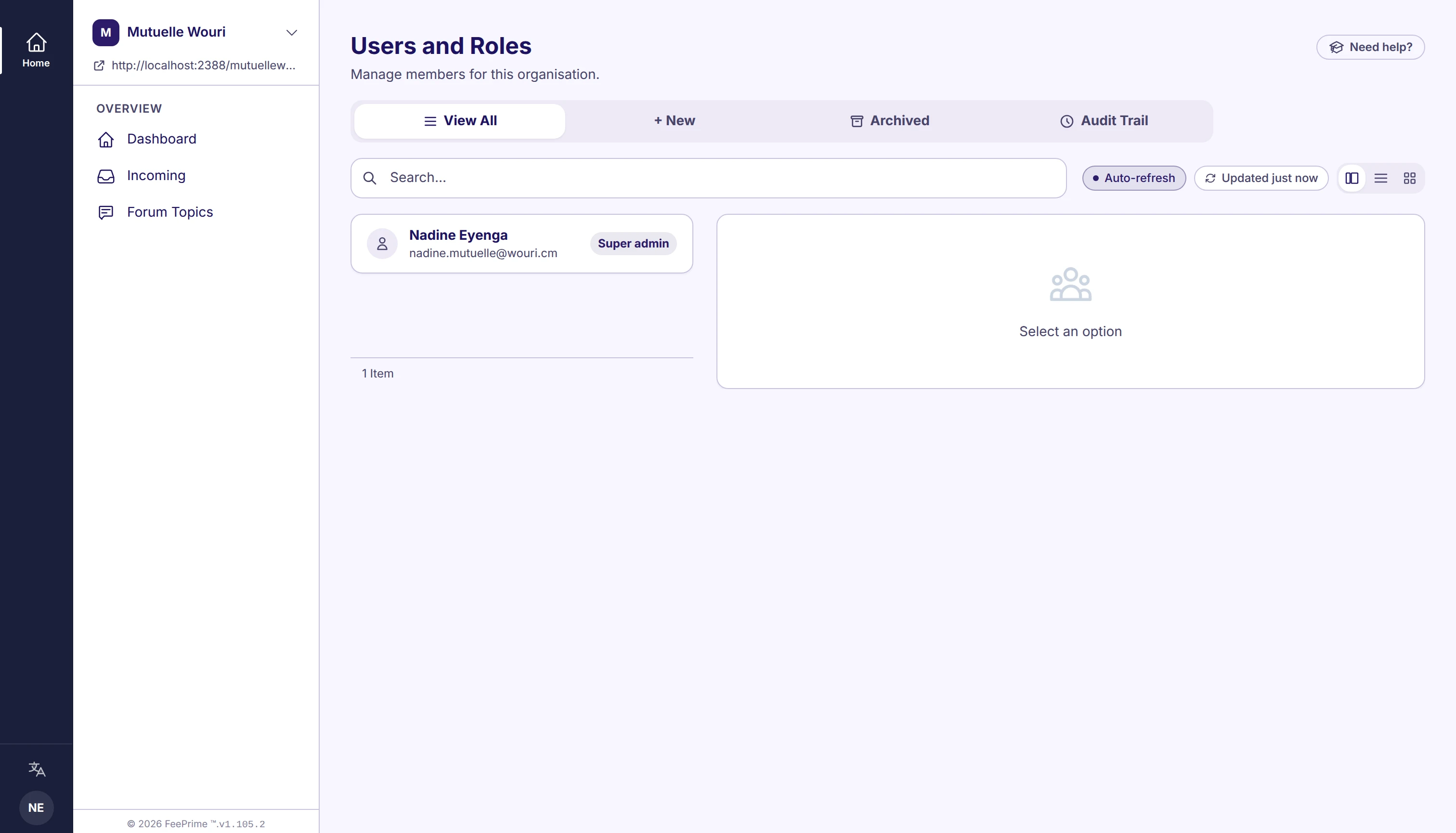 members screen in FeePrime (Mutuelle Wouri).
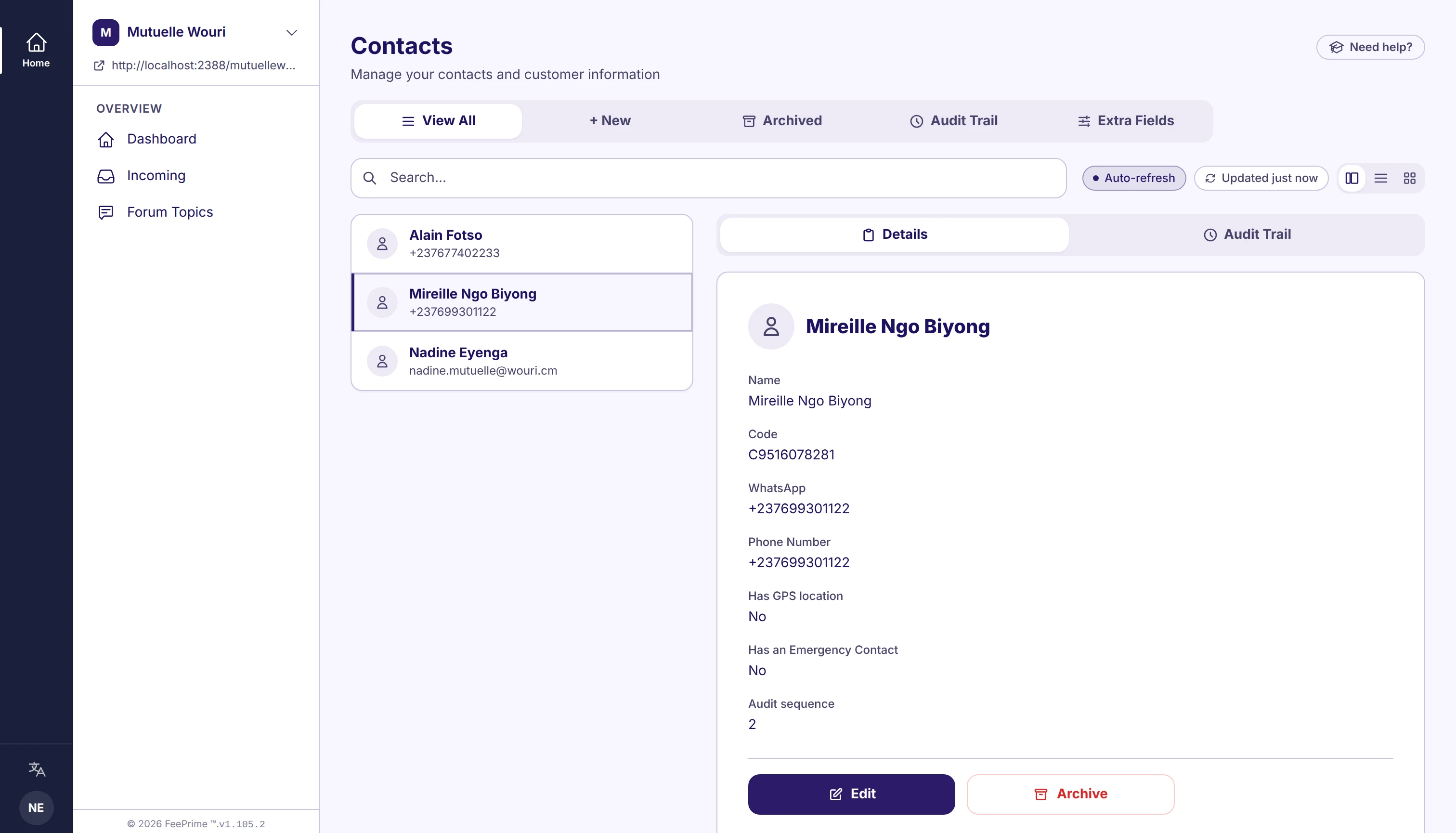 contacts screen in FeePrime (Mutuelle Wouri).
2. Why shares — and not separate member balances
A shared fund is not a row of separate savings accounts sitting side by side. It is one pot with several owners, and that pot grows when the group lends money and earns interest or fees.
Never try to track a growing shared fund as flat cash balances. If you only record that Amina put in 400,000 XAF, Nadège put in 350,000 XAF, and Awa put in 250,000 XAF, what happens when the pool earns 200,000 XAF from lending? On paper, each member’s balance is still frozen at what they deposited. The 200,000 XAF of growth belongs to nobody — and that is where arguments begin.
Recording ownership as shares solves this permanently. Each member owns a proportion of the pot. When the fund grows, the value of every share rises in the exact same ratio.
Look at how the math holds together for Akwa Bakers Cooperative with a starting share price of 10,000 XAF:
DAY 1 — 100 shares at 10,000 XAF each  (Total pot: 1,000,000 XAF)
  Amina    40 shares  (40%)  ->   400,000 XAF
  Nadège   35 shares  (35%)  ->   350,000 XAF
  Awa      25 shares  (25%)  ->   250,000 XAF

                 |
                 v  Pool lends out funds and earns +200,000 XAF

LATER — Same 100 shares, now 12,000 XAF each  (Total pot: 1,200,000 XAF)
  Amina    40 shares  (40%)  ->   480,000 XAF
  Nadège   35 shares  (35%)  ->   420,000 XAF
  Awa      25 shares  (25%)  ->   300,000 XAF
Nobody had to invent a complicated formula at year-end. Every member’s proportion stayed intact, and everyone shared the growth fairly. That is the arrangement your members thought they were joining.
3. One currency per pool
A liquidity pool holds one currency, for the exact same reason an account in Cash / Money / Cash Accounts holds one currency. A share price can only be clear when every franc or euro in the pot speaks the same unit.
Suppose Akwa Bakers Cooperative grows and five diaspora members in Paris want to save in EUR alongside the Douala members saving in XAF. Do not try to squeeze both into one pool.
- Create one pool in XAF for local members.
- Create a second pool in EUR for diaspora members.
Never convert two currencies in your head inside a single pool. Exchange rates move every week. Mixing currencies in one pot makes the share price impossible to audit and guarantees disagreements when someone asks to cash out.
4. How a shared fund fits with your members and daily cash
A liquidity pool does not live on an island. It sits neatly alongside the rest of your membership and cash setup:
Members / Membership / Memberships    -->  Who belongs to the group
                 |
                 v
Cash / Planning / Liquidity Pools     -->  The shared pot & each member's shares
                 |
                 v
Cash / Money / Cash Accounts & Loans  -->  Where the money sits & how it lends
                 |
                 v
Settings / Access / Spending Controls -->  Who must approve before money moves
You do not have to turn on every feature on day one:
- Small 10-member savings circle in one city? Start simple: keep your member roster clean in Members / Membership / Memberships, set up one XAF pool in Cash / Planning / Liquidity Pools, and share the numbers openly at each meeting.
- Larger cooperative lending across branches or currencies? Add separate pools per currency, track lending cleanly under Cash / Money / Loans, and enforce formal approval limits under Settings / Access / Spending Controls.
5. Protecting other people’s money
This part is worth saying plainly, because it is what makes shared funds different from every other module in FeePrime.
Everywhere else in the system, a mistake costs your own business. Here, a mistake costs your members — often neighbours, family friends, and fellow shop owners in a group that only survives because everybody trusts the books.
That is why the everyday discipline from FeePrime Essentials stops feeling like paperwork here and becomes the whole point:
- A second person approving every move. Set up maker-and-checker rules under Settings / Access / Spending Controls so the person who enters a payout or adjustment is not the same person who approves it. No single treasurer should be able to move members’ money alone.
- An audit trail on every change. FeePrime records who made each entry and when. When a member asks about a figure from six months ago, you answer with a named, dated record — not a shrug.
- Nothing deleted. If someone accidentally credits 5 shares to Nadège instead of Awa, never delete the old entry or rename a member profile to hide the slip. Record a clear correction so the full story stays visible to the committee.
If your organisation only turns on second-person approval in one place across all of FeePrime, turn it on here. Trust takes years to build and one quiet, unexplained edit to lose.
Try it
Head over to staging.feeprime.com — a practice copy of FeePrime, kept apart from the real thing — and run through this five-minute drill:
- Open Cash / Planning / Liquidity Pools and create a practice pool with a clear name, a single currency (such as XAF), and a clean share price (such as 10,000 XAF).
- Open Members / Membership / Memberships and pick three practice members (or create three test names).
- Record different share counts for the three members — for example, 40, 35, and 25 shares.
- Take a piece of paper and calculate each member’s stake by hand if the pool grows by 20%, then compare your starting numbers against the pool report.
- Visit Settings / Access / Spending Controls to see where your committee can require a second person to approve moves before money leaves the fund.
Once you see the share math line up on paper and on screen, you are ready to run a real member fund with confidence.