
Recording and tracking member loans
Before you start, sign in and open Cash / Money / Loans. You will also use Cash / Planning / Liquidity Pools (your shared funds) and Sales / Customers / Contacts.
Can’t find it? It may be turned off for your business, or your account may not be allowed to open it. Ask the person who set up your FeePrime. They can fix both.

Photo: john amachaab on Unsplash
A loan lends money from a shared fund to a member. For most savings circles, staff cooperatives, and trade associations, lending is the very reason members pool their money in the first place.
It is also where notebooks fail fastest. A treasurer writes “Paul — 100,000” on a loose sheet in February. By April, Paul thinks he has until May, two members disagree on the repayment figure, and nobody can tell how much cash should actually be sitting in the pot.
FeePrime puts every loan, the shared fund it came from, and the exact repayment promise in one shared record so your group keeps both its money and its friendships intact.
1. How a shared fund and a loan fit together
A shared fund with lending is one closed loop. Members contribute cash into a pool, the group lends money out of that pool, and borrowers pay the money back into the same pool.
Member Contributions In
         │
         ▼
┌─────────────────────────────┐
│     Shared Fund (Pool)      │
│  Cash / Planning /          │
│  Liquidity Pools            │
└──────────────┬──────────────┘
               │  Loan out (e.g. 100,000 XAF)
               ▼
┌─────────────────────────────┐
│     Member Loan Record      │
│  Cash / Money / Loans       │
│  • Contact (borrower)       │
│  • Pool                     │
│  • Loan amount              │
│  • Return amount            │
│  • Deadline                 │
└──────────────┬──────────────┘
               │  Repayment back (e.g. 115,000 XAF)
               ▼
┌─────────────────────────────┐
│     Shared Fund (Pool)      │
│  Pot restored + surplus     │
└─────────────────────────────┘
Understand only one half of that loop and your balances will look random. Money lent out is not an expense—it has left the pot temporarily and is owed back to it.
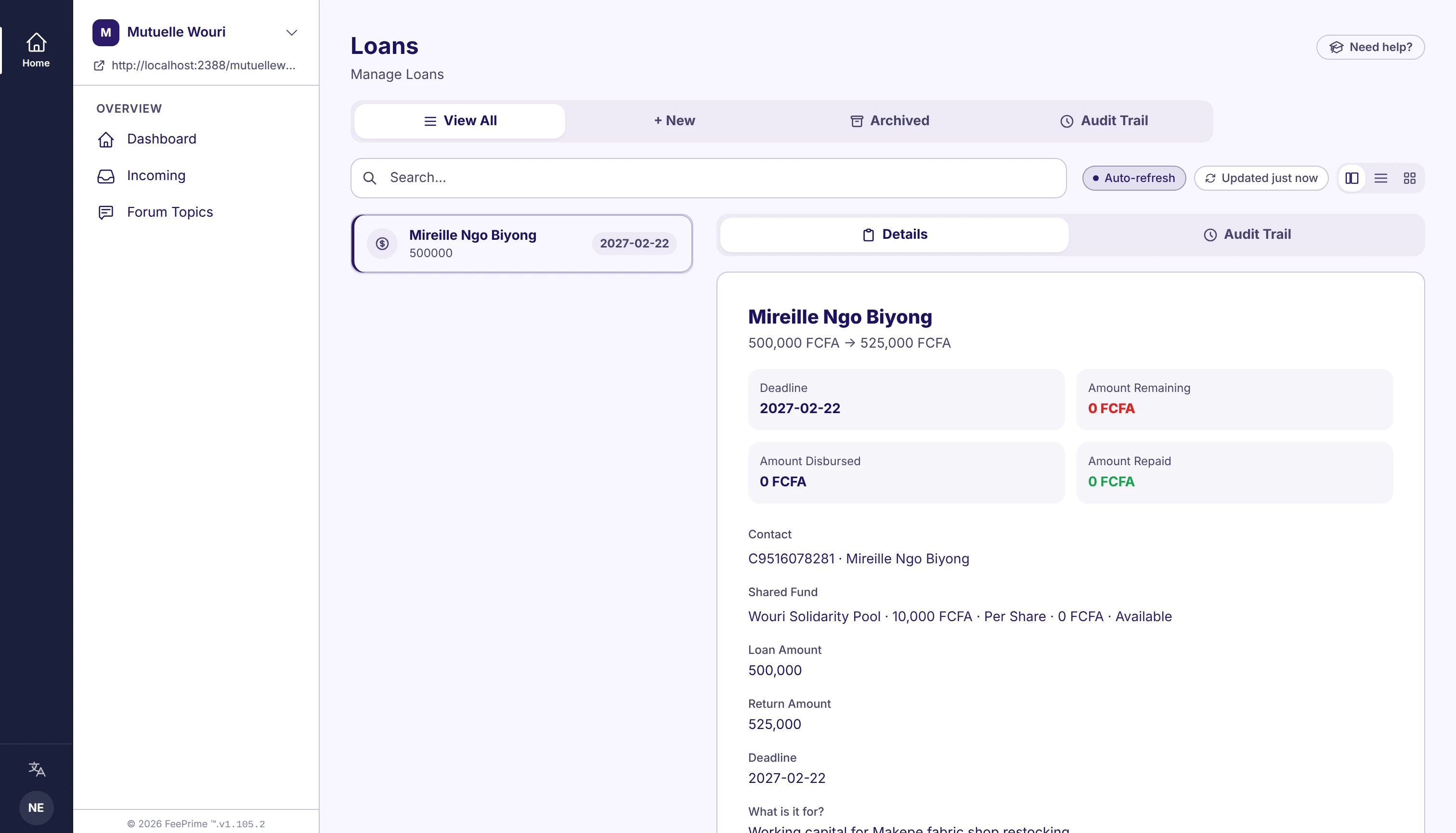 loans screen in FeePrime (Mutuelle Wouri).
2. The five facts every loan records
When you open Cash / Money / Loans to record a member loan, FeePrime captures five plain facts:
- The contact borrowing the money, picked from Sales / Customers / Contacts.
- The pool the money comes out of, from Cash / Planning / Liquidity Pools.
- The loan amount — the exact cash handed to the member today.
- The return amount — the exact total the member agrees to pay back.
- The deadline — the agreed date by which the repayment is due.
Watch out for two everyday mistakes right here:
- Search before you add a contact. If Nadège Fouda already contributes to the group, select her existing record in Sales / Customers / Contacts. Creating a second “Nadege F.” splits her borrowing history across two cards and hides what she already owes.
- Never rename an old contact for someone new. If a member leaves the association, keep their record untouched so past loans stay tied to the right person.
3. Why FeePrime records a return amount instead of an interest rate
Notice what is missing from those five fields: there is no percentage box. The amount borrowed and the amount to be returned are stored as two separate numbers.
That is deliberate. The return amount is the exact figure both sides agreed.
Take Sunrise Bakery’s staff savings circle in Douala. Paul needs cash to stock extra bags of Flour 50kg for his family shop before Easter. The committee agrees: “Borrow 100,000 XAF today, return 115,000 XAF by 31 March.”
Every person in the room understands that sentence immediately, and nobody can misread it two months later.
A percentage rate invites endless arguments. Does 5% compound every month or stay flat? Do you count a 30-day month or exact calendar days? Was the 2,000 XAF processing fee inside the rate or on top? Neighbours and colleagues who see each other every week do not want to spend Sunday afternoon fighting over interest formulas.
Writing down 100,000 XAF out and 115,000 XAF back settles the math on day one.
4. Why every loan is tied to one specific pool
Every loan must name the exact shared fund it came from in Cash / Planning / Liquidity Pools. That link is what keeps each pot’s sums honest.
Suppose Akwa Traders Association runs two separate pools:
- Emergency Solidarity Pool — quick, zero-surplus help when a member has a hospital bill.
- Business Credit Pool — short-term restocking loans with an agreed return amount.
If Amina the treasurer hands Awa Ndiaye 250,000 XAF from the Business Credit Pool, she must select the Business Credit Pool on the loan. Pick the exact pool every time. Choosing the wrong pool makes the Emergency fund look short by 250,000 XAF while the Business Credit fund looks richer than it really is.
- Running a small 15-member savings circle with one pot? Keep just one shared fund in Cash / Planning / Liquidity Pools. Every contribution goes in, every loan comes out of it, and nothing gets complicated.
- Running a larger cooperative with separate funds and committee tiers? Create one pool per purpose so each fund has its own clear balance and lending rules.
5. Deadlines, follow-up, and checking what is still owed
In most member organisations, a deadline is not a courtroom threat—it is a social agreement. It is the date the committee will ask about the loan in front of people whose respect the borrower values.
That social accountability works well, as long as the date is written down rather than remembered.
A deadline saved in Cash / Money / Loans is a shared fact. A deadline kept in someone’s head is an argument waiting to happen between two people who still have to sit at the same table next month.
Before every monthly meeting, open Cash / Money / Loans and run the loans summary. In a few seconds you can see:
- Every active loan and which pool funded it.
- What was lent out and what is expected back.
- How much is still owed and which deadlines are coming up or overdue.
That five-minute check replaces an hour of flipping through exercise books while members wait.
6. Protecting trust when money is lent out
Everything you learned about managing shared funds matters even more once loans begin. Three habits protect both the treasurer and the members:
- Get a second person to approve. In a small circle, the president or secretary checks the loan details before cash changes hands. In a larger cooperative, require formal committee sign-off before releasing funds.
- Never delete a loan to fix a mistake. If you type 2,500,000 XAF instead of 250,000 XAF for Junior’s motorbike repair loan, do not try to erase the record silently. Correct it cleanly so the audit trail stays intact and any member reviewing the books can see what happened.
- Let the members whose money it is see the terms. FeePrime keeps the numbers straight, but transparency is a leadership choice the software cannot force. A fund where only the treasurer knows who borrowed what is heading for a tense meeting—no matter how honest the treasurer is.
Try it
Open staging.feeprime.com — a practice copy of FeePrime kept apart from your real business data — and walk through one complete loan in five minutes:
- Open Sales / Customers / Contacts and search for an existing member (or create a practice contact like Paul — Sunrise Bakery).
- Open Cash / Planning / Liquidity Pools and note the name and current balance of your practice shared fund.
- Open Cash / Money / Loans and record a new loan: pick your contact, select that pool, enter 100,000 as the loan amount, 115,000 as the return amount, and set a deadline one month from today.
- Run the loans summary in Cash / Money / Loans and check how the amount still owed and the deadline appear.
- Re-open Cash / Planning / Liquidity Pools to verify how the loan is reflected against the fund.
Once you have walked through one practice loan end to end, running your next group meeting from real numbers will feel effortless.