
Collection runs: buying in the field
Before you start, sign in and open Operations / Field / Collection Runs. You will also use Settings / Business / Business Locations, Cash / Money / Cash Accounts, and Procurements / Paying / Bills.
Can’t find one? It may be turned off for your business, or your account may not be allowed to open it. Ask the person who set up your FeePrime. They can fix both.
Photo: Aditya Septiansyah on Unsplash
Some businesses never wait for a supplier truck to pull up at the gate. They go out and buy.
At Sunrise Bakery in Douala, Junior drives the delivery van out to farms in Moungo at 5:30 AM with 400,000 XAF in cash to buy fresh eggs, butter, and plantains directly from producers. A cocoa buyer in Nkongsamba does the same thing on a larger scale: an agent takes a truck and a cash float, drives from village to village buying cocoa consignments at the day’s price, and comes back loaded.
Without a system, that whole day is a blind spot. Money left the safe in the morning, goods might be sitting in the back of a van somewhere on a dirt road, and nobody knows what was actually spent until someone empties crumpled receipts onto a desk at 8 PM.
A collection run turns that entire field trip into one clean record in FeePrime—tracking the vehicle, the stock on board, the cash float, and the final handover at your depot.
1. Before you leave: set up the vehicle and the cash float
Two simple pieces make collection runs work, and both come from tools you may already use in FeePrime:
- The vehicle (or field buyer) is a business location. Open Settings / Business / Business Locations and create a location for the truck, van, or buying agent—for example, Sunrise Van LT-482 or Junior Mobile Buying. In FeePrime, a location does not have to have four walls. A truck holds stock just like a warehouse does.
- The cash float is a real cash account. Open Cash / Money / Cash Accounts and create a dedicated float account for the buyer or vehicle—for example, Junior Field Float. Transfer the morning’s cash into that account before departure.
One small shop that only receives deliveries at the door? You do not need collection runs at all. Leave this off and use normal supplier bills or purchase orders—nothing breaks. Collection runs are built for teams that send people out with money to buy on the road or at rural markets.
Never mix personal money or till cash with a field float. Giving an agent a dedicated float account means you can see at a glance how much money went out, how much was spent on goods, and how much cash should come back in the evening.
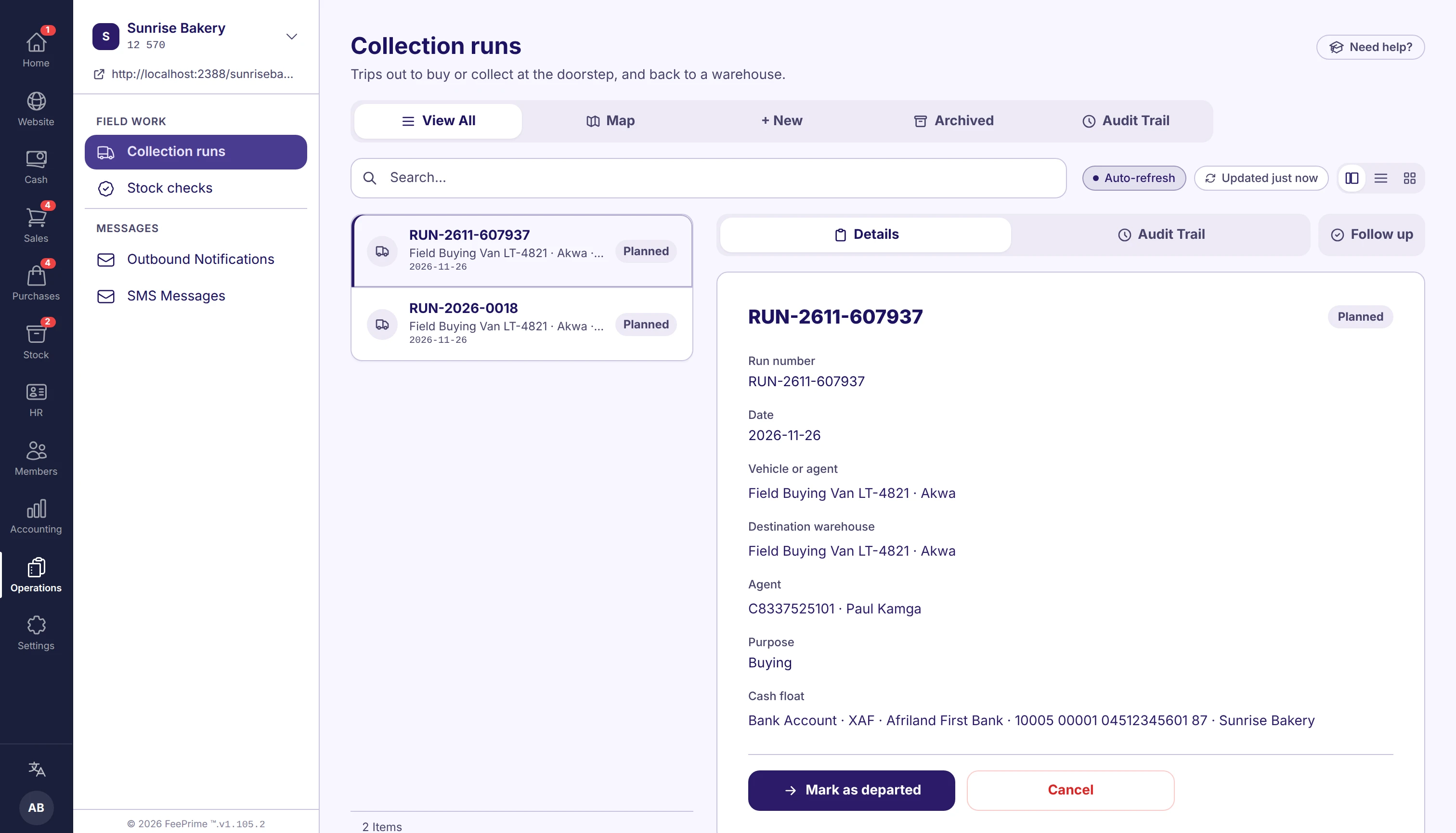 collection runs screen in FeePrime (Sunrise Bakery).
2. What a collection run holds—and how it moves
When Amina the manager sends Junior out for the morning buying trip, she opens Operations / Field / Collection Runs and starts a new run. Every run brings seven facts together in one place:
- Run number and run date so every trip has a clear name and day.
- Mobile location—the vehicle or agent carrying the goods you buy.
- Destination—the store or warehouse where the load will be delivered (for example, Akwa Bakery).
- Agent—the team member doing the buying.
- Purpose—a short note on what the trip is for (such as Moungo egg and butter collection or Weekly cocoa buying route).
- Cash float account—the real cash account holding the money the agent set out with.
From morning departure to evening wrap-up, every run follows one clear path:
   [ Departed ]  ───────▶  Roadside buying (offline or online)
        │                  • Goods land on the MOBILE LOCATION (the truck)
        │                  • Payments come out of the CASH FLOAT ACCOUNT
        │
        ├──▶ If trip is called off ──▶ [ Cancelled ] (must record a reason)
        ▼
   [ Arrived ]   ───────▶  Back at destination (Akwa Bakery / main depot)
        │                  • Unload goods from vehicle ──▶ destination
        │                  • Square up float (out vs spent vs returned)
        ▼
   [ Closed ]    ───────▶  Truck is empty, float is reconciled, day is real
3. Why the vehicle holds stock and cash in real time
Think about what happens on a normal Tuesday morning at Sunrise Bakery:
- At 6:00 AM, Amina transfers 400,000 XAF into Junior Field Float and marks the run Departed.
- At 8:15 AM, Junior buys 25 crates of eggs for 125,000 XAF from a farm outside Mbanga.
- At 10:30 AM, he buys fresh butter and farm produce worth 195,000 XAF at a second stop.
Because the van is a real business location and the float is a real cash account, you do not have a mystery gap between the first purchase and the evening unload. At midday, once Junior’s phone syncs, Amina can see two exact truths:
- Stock: 25 crates of eggs plus the butter are physically on Sunrise Van LT-482—not missing, and not falsely counted as already sitting in the Akwa bakery kitchen.
- Cash: Junior Field Float started at 400,000 XAF, spent 320,000 XAF, and should hold 80,000 XAF in cash.
Never wait until the end of the week to check what is sitting on a vehicle location. If a truck always shows leftover stock in FeePrime when the truck bed is physically empty, a run was not closed properly or an unload was missed.
4. Buying where there is no signal
Rural farms, village collection points, and deep market lanes rarely have reliable mobile data. That is exactly why FeePrime’s offline mode matters here.
Junior records each purchase on his phone at the moment of the purchase, standing right in front of the farmer or seller: who he bought from, what he bought, how much, and at what price. With no signal at all. The phone holds every entry safely and sends everything automatically as soon as the van hits mobile coverage on the road back.
Why does this matter so much?
- No evening notebook guesswork. Typing up a whole day from a stained spiral notebook at 8 PM is where wrong prices, missing receipts, and arguments start.
- Agreement on the spot. When the quantity and price are entered standing beside the producer, both sides know the exact figure before cash changes hands.
Never promise to “type it all in back at the depot.” Record the deal where the deal happens—even when the phone has zero bars.
5. Arriving back and closing the run
When the van pulls back into Akwa Bakery, the run moves to Arrived. Now two physical checks happen before anyone goes home:
- Unload the stock: Count what actually comes off the van and move the goods from the mobile location (Sunrise Van LT-482) to the destination (Akwa Bakery). Check Inventory / Stock / Inventory Items if you want to confirm the vehicle location is back to zero.
- Square the cash float: Count the remaining notes Junior hands back against what the cash float account says should be left (in our example, 80,000 XAF). What went out, what was spent, and what came back must match.
Once the goods are unloaded and the float is squared up, mark the run Closed.
- Never leave a finished run open. A run that never gets closed leaves imaginary stock sitting on a truck in your records and cash nobody has accounted for. Closing the run is what makes the day’s buying real.
- Trip called off before buying? Never abandon the record or rewrite the date for next week. Mark the run Cancelled and enter the reason (for example, Van breakdown before first stop). That keeps your audit trail honest.
6. Settling later: linking bills to a collection run
Not every roadside purchase is settled with cash on the spot. Many regular suppliers—such as a cocoa cooperative or a poultry farmer like Nadège Fouda who supplies Sunrise Bakery twice a week—prefer to be paid once a week or once a month.
In Procurements / Paying / Bills, a supplier bill carries a collection run link. That lets Amina record what was collected on each trip during the month, and then settle those collections cleanly against a bill afterwards.
Instead of forty loose slips and forty tiny payouts, a month of regular buying from the same producer becomes a clean, traceable bill you can pay and reconcile in one step.
Try it
Open staging.feeprime.com—a practice copy of FeePrime, kept apart from the real thing—and run one field trip from start to finish in 5 minutes:
- Open Settings / Business / Business Locations and create a mobile location named Practice Buying Van.
- Open Cash / Money / Cash Accounts and create a float account named Practice Field Float, then put a starting cash amount (for example, 200,000 XAF) into it.
- Open Operations / Field / Collection Runs and create a new run using Practice Buying Van as the mobile location, your main store as the destination, and Practice Field Float as the cash float account. Mark it Departed.
- Check the stock on Practice Buying Van and the balance on Practice Field Float to see how FeePrime tracks both while the trip is live.
- Move the run to Arrived, bring the goods and remaining float back to your destination, and mark the run Closed.
Once you have walked one practice run from Departed to Closed, real morning dispatches with your buyers will feel straightforward.