
Membership reports
Before you start, sign in and open Members / Reports / Membership Reports.
Can’t find it? It may be turned off for your business, or your account may not be allowed to open it. Ask the person who set up your FeePrime. They can fix both.

Every association, cooperative, or mutual aid group reaches the same uncomfortable moment. It is Friday afternoon before the monthly meeting. Someone asks, “How much is actually in our fund, and who still owes dues?” If the treasurer has to flip through three exercise books and forty WhatsApp messages to answer, trust drains out of the room fast.
Even worse is quiet drift. A trade group like the Douala Bakers & Traders Association can celebrate 70 members on paper without noticing that 20 memberships expire next month, 14 members have not paid this quarter, and half the shared fund is tied up in two late loans.
Membership Reports puts the live truth on one screen. It carries a report type and, where relevant, a liquidity pool. Four report types, four plain questions — no spreadsheets to stitch together before a meeting.
1. One screen, four reports (and what your group actually needs)
When you open Members / Reports / Membership Reports, you choose one of four report types:
- Memberships status — who belongs, at what tier, and who is about to lapse.
- Contributions summary — what dues were expected, what arrived, and who is short.
- Loans summary — what has been lent from the fund, to whom, and what is overdue.
- Shared fund summary — what sits in the liquidity pool and how it is held.
Running a simple club, gym, or trade association that only collects dues and never lends? Use Memberships status and Contributions summary, and ignore the other two. Leave loans and liquidity pools off — nothing breaks.
Running a savings group, cooperative, or mutual aid fund that lends from a shared pot? Use all four reports together, and select the matching liquidity pool (set up under Cash / Planning / Liquidity Pools) whenever a report asks for it.
 members screen in FeePrime (Mutuelle Wouri).
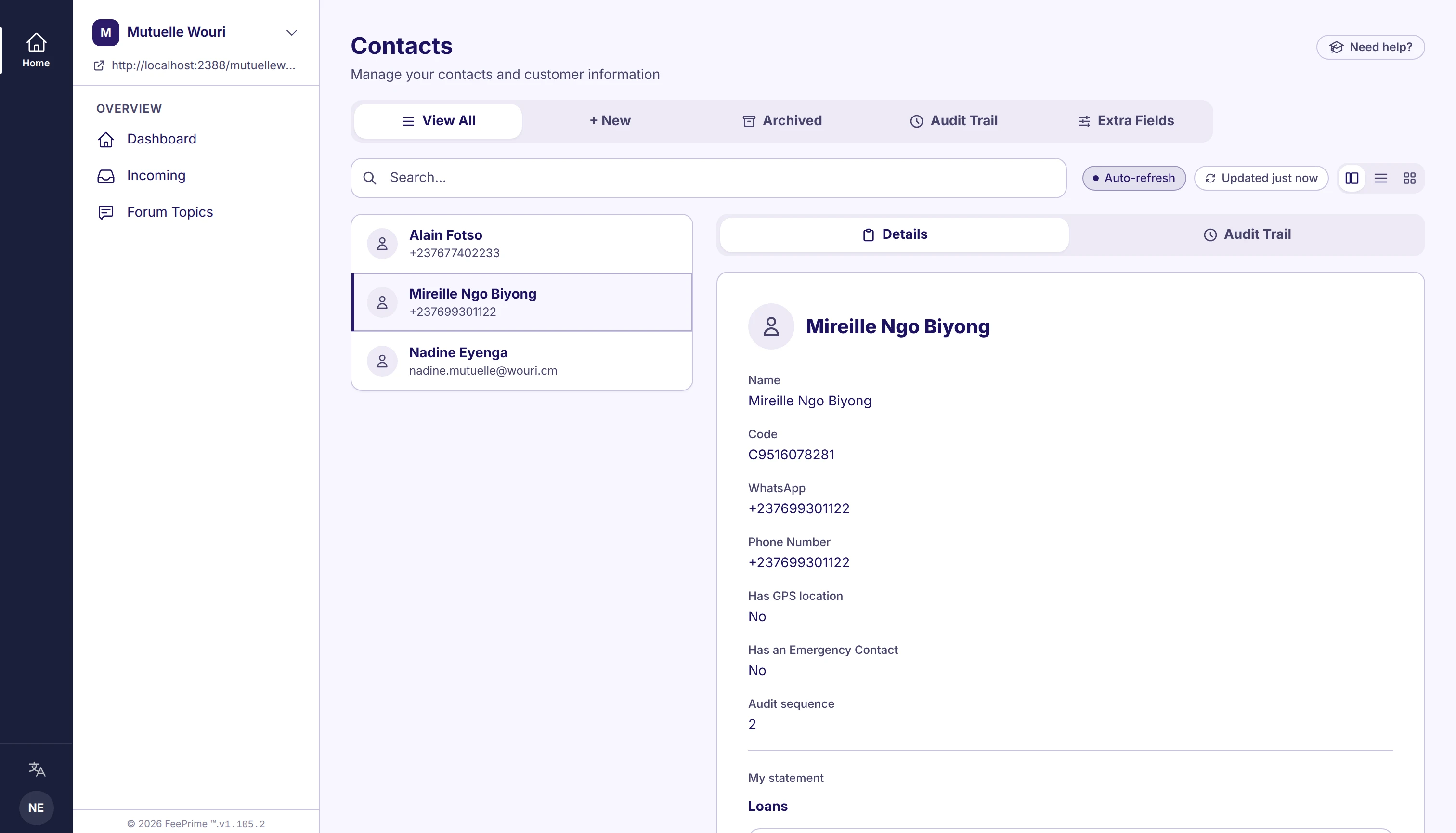 contacts screen in FeePrime (Mutuelle Wouri).
2. Memberships status — spot renewals before people quietly leave
This report is your live register. It shows who is a member, at what tier, and whether their membership is current.
Read the lapsing-soon number before the total. That single figure matters more than headcount.
Imagine Amina checks the register for the Douala Bakers & Traders Association. Total active members has stayed at 68 for three straight months — including Nadège Fouda from Sunrise Bakery and Awa Ndiaye. On the surface, the association looks steady. Then she checks upcoming expiries and sees 22 annual memberships expiring within the next 30 days.
An organisation with flat headcount and a wave of expiries next month is not stable — it is about to shrink. Follow up while members are still active. Renewing someone two weeks before expiry takes a quick message; winning back someone who lapsed three months ago takes ten times the effort.
3. Contributions summary — act on the gap, not just the total
This report compares what was expected from member contributions against what actually came in, and shows who is short.
Suppose 60 members each owe 15,000 XAF this month — 900,000 XAF expected. Collecting 720,000 XAF sounds reassuring if you only read the headline total. The real story is the 180,000 XAF gap: 12 specific members who have not paid yet.
The list of who is short is the part you can act on this week. Use it to check records under Members / Membership / Member Contributions and send a calm payment request from Members / Membership / Member Payment Requests while a gentle nudge still works.
Never wait until a member is five months behind. One missed 15,000 XAF month is easy to settle. A 75,000 XAF backlog makes people feel embarrassed and quietly stop attending meetings.
4. Loans summary — keep lending visible and fair
If your group lends from its shared fund (tracked through Cash / Money / Loans), this report shows what has been lent out, to whom, and what is still outstanding against its repayment deadline.
Suppose the fund has 1,500,000 XAF out on loan across five members. Four repayments are right on schedule, and one 400,000 XAF loan is two weeks past its due date. Catching that at two weeks lets the committee agree on a clear repayment plan before the delay turns into a dispute.
Review the Loans summary before every committee meeting. Not because you suspect anyone of bad faith, but because a fund whose position is checked regularly and openly stays a fund members trust.
5. Shared fund summary — know what is actually in the pot
Select your liquidity pool to view the pool itself: what is inside it and how it is held.
Read Shared fund summary right beside Loans summary. Together, they give you the full financial picture of the fund:
- What cash is actually sitting in the pot right now.
- What money is currently out on loan to members.
- Whose share of the fund it represents.
Never treat money sitting in the pool and money lent out as the same thing. If a member has an urgent payout request tomorrow, you can only pay them from cash that is actually in the pot — not from loans that are still overdue.
6. Reading all four reports together
Each report answers one focused question. The true health of your organisation sits in how the four answers fit together:
MEMBERSHIP HEALTH CHECK (READ ALL FOUR TOGETHER)
------------------------------------------------
1. Memberships status    --> Is the group growing or quietly lapsing?
2. Contributions summary --> Is expected money actually arriving?
3. Loans summary         --> Is money lent out coming back on time?
4. Shared fund summary   --> Does the pot match what everyone believes?
Never run just one report and declare the group healthy. Any single report can look comforting while a real problem grows next door:
- Growing memberships + widening contributions gap: You are recruiting people who sign up on paper and never pay their dues.
- Strong shared fund balance + rising overdue loans: The pot looks healthy on paper, but real cash is stuck outside and cannot cover payouts.
- 100% dues paid this month + a wave of upcoming expiries: Your loyal payers are current today, yet a third of the group could drop off next month if nobody reminds them to renew.
Check people against money, and pool cash against loans. That takes five minutes and prevents almost every end-of-year shock.
7. Report to members, not just about them
The best habit any committee can build is simple: treat these four reports as what you share with members, not as private paperwork locked in a folder.
Before each gathering scheduled in Members / Engagement / Meetings, run the reports and turn them into two or three plain sentences — and share a short recap afterward through Members / Engagement / Member Updates. For example:
“We have 68 active members with 9 renewals due next month. This month’s contributions reached 840,000 XAF of 900,000 XAF expected, with 4 members following up this week. Our shared fund holds 2,150,000 XAF in cash plus 950,000 XAF in current loans, with zero loans overdue.”
Any member can read that in fifteen seconds and know their money is safe. Routine openness all year is far easier than defending twelve months of numbers in a tense annual general meeting.
Try it
Open staging.feeprime.com — a practice copy of FeePrime, kept apart from the real thing — and finish these five checks in five minutes:
- Sign in and open Members / Reports / Membership Reports.
- Run Memberships status and look for members who are already lapsed or expiring soon.
- Switch the report type to Contributions summary and spot the gap between expected and collected dues, plus who is short.
- Run Loans summary and Shared fund summary for a liquidity pool, checking whether any loan is past its deadline.
- Write the two plain sentences you would read out at your next committee meeting — that short summary is the whole point of these reports.
Once you run this four-report check once a month, committee meetings become calmer, faster, and far more trusted.