
Receiving goods
Before you start, sign in and open Stock / Movements / Goods Receipts.
Can’t find it? It may be turned off for your business, or your account may not be allowed to open it. Ask the person who set up your FeePrime. They can fix both.

Photo: CHUTTERSNAP on Unsplash
This is the most important lesson in the course.
Picture 7:15 AM at Sunrise Bakery in Akwa. A supplier lorry is blocking the gate, the driver has three more drops across Douala, and he is holding out a clipboard for a quick signature on 100 bags of Flour 50kg—2,250,000 XAF worth of stock. Your storekeeper is busy, signs for 100, and waves the truck out.
Two days later, Amina counts the store. Only 94 bags are there, two of them are rain-stained from a torn tarpaulin, and the supplier’s bill arrives for all 100. Receiving goods is where SMEs quietly lose money without noticing—because there is always a driver at the gate pushing you to rush.
1. What you record when goods arrive
A goods receipt is your shop’s honest record of what actually came off the truck. Every receipt captures:
- A receipt number and the date the goods arrived.
- The purchase order you are receiving against.
- The supplier who sent the delivery.
- The location receiving the stock—which shop or store (for example, Akwa bakery rather than Bonapriso shop).
- The supplier delivery note number copied from the driver’s own paperwork.
- The lines, showing exactly which items arrived and the real quantity you counted.
- Notes and proof, where you explain any problem and attach a phone photo.
Linking the receipt to the purchase order matters. It ties what you ordered, what landed in your store, and what the supplier later bills you into one unbroken trail.
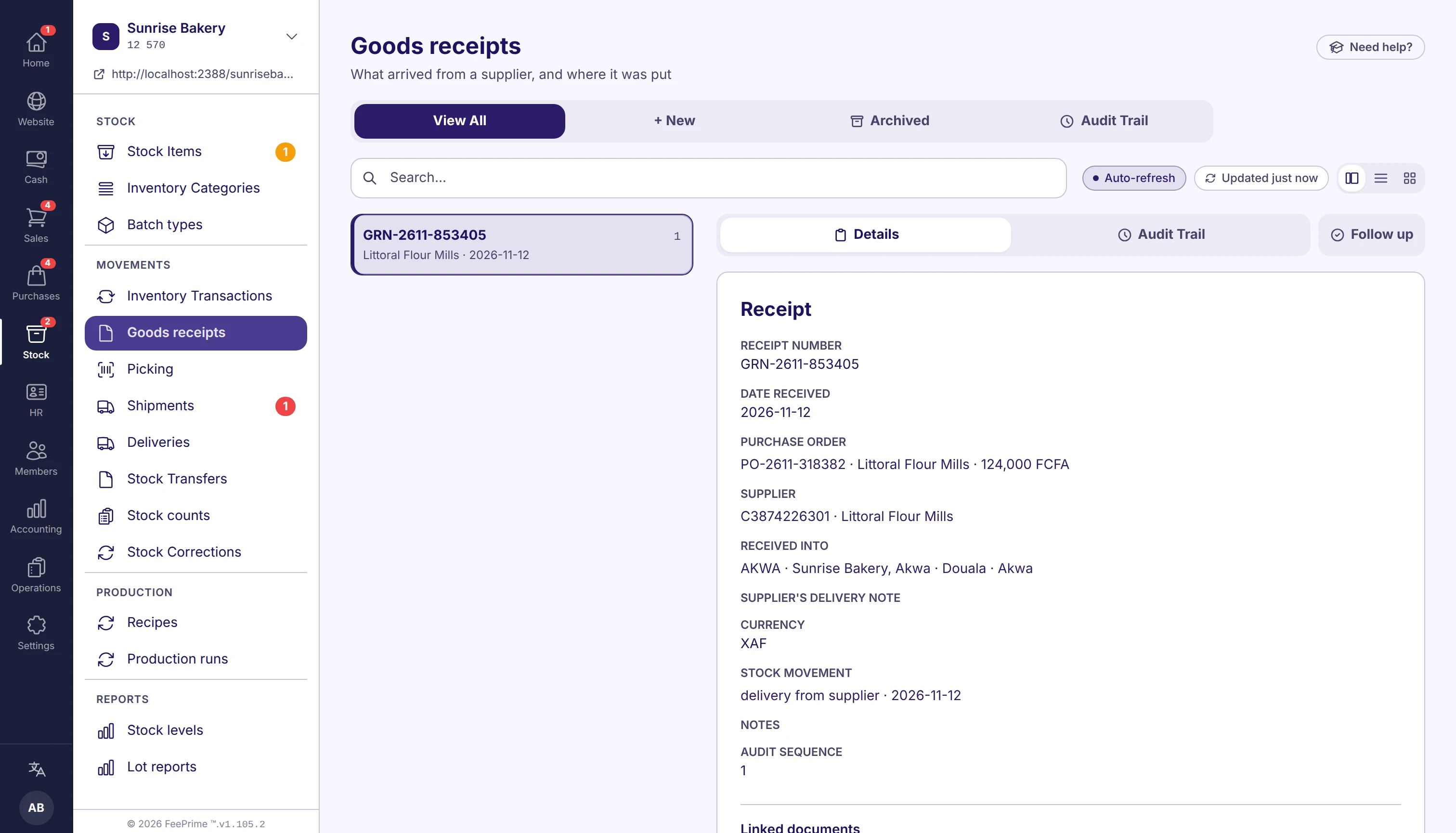 goods receipts screen in FeePrime (Sunrise Bakery).
2. Receiving happens in three stages, not one
A delivery does not teleport straight from the back of a lorry onto your shelves. FeePrime separates receiving into three real stages so your team always knows where stock stands:
Purchase Order  (100 bags ordered -> 100 incoming)
       │
       ▼
┌────────────────────────────────────────────────────────────┐
│   Goods Receipt   (Stock / Movements / Goods Receipts)     │
│                                                            │
│   1. Received   ──▶ Lorry unloaded and bags counted        │
│   2. Inspected  ──▶ Quality checked before driver leaves   │
│   3. Put away   ──▶ Stacked in its place, ready to find    │
└────────────────────────────────────────────────────────────┘
       │
       ├──▶ Stock moves: on-hand goes UP, incoming goes DOWN
       └──▶ Discrepancy flagged before the supplier's Bill arrives
Keep these three moments apart—each one protects you from a different headache:
- Received, not put away means stock nobody can find when Paul needs flour for the morning bake.
- Received, not inspected means goods you accepted without looking. Once the lorry pulls out of your gate, damaged or expired stock becomes your loss, not the supplier’s.
- Put away means the goods are checked, counted, and sitting in the right spot for your staff to use or sell.
If a receipt was created against the wrong order or the wrong shop, you can cancel it and write a clear reason. Never try to hide a mistake by leaving bad data in the system.
3. Count what arrived, never what you ordered
Write down what actually landed on your floor, never what the purchase order asked for.
That single habit pays for itself every month. Suppose Sunrise Bakery ordered 100 bags of Flour 50kg at 22,500 XAF each, and only 94 arrive. Receive 94.
Typing 100 feels quicker and harmless while the driver is waiting, but it breaks three things at once:
- It creates ghost stock. Six bags appear in your on-hand count that do not exist in your store, so you reorder too late and run out mid-week.
- It wipes out your proof. You have just signed off in your own books that the supplier delivered everything in full.
- It defeats the three-way check. FeePrime compares three numbers: what you ordered, what you received, and what you were billed. If your receipt says 100, all three agree—and a supplier bill charging you 135,000 XAF for six missing bags sails straight through without a warning.
What about split deliveries? Suppliers often send stock in two drops—say, 60 bags on Monday and 40 on Thursday. Receive 60 on Monday. The remaining 40 stay open on the purchase order as incoming stock until Thursday’s truck arrives, when you log a second receipt for the balance.
The gap between what you ordered and what arrived is not a problem to cover up. Catching that gap is the entire point of receiving.
4. Flag discrepancies and take proof at the gate
Whenever the count is short, extra items show up unasked, or boxes arrive crushed, never let the driver leave before you log the discrepancy and take a photo.
Tick discrepancy, then write clearly in discrepancy notes. Compare the difference two weeks later when accounting queries the supplier’s bill:
- Too vague: “Six short.”
- Settles the dispute: “Six bags of Flour 50kg short (94 of 100 received). Two bags water-stained on pallet 2. Driver agreed at gate; supplier promised the 6 missing bags on Tuesday.”
Next, use the proof field to snap a photo straight from your phone—a crushed carton, a torn flour sack, or the signed delivery note showing the correction. A clear photo taken at the unloading bay before the lorry drives off is worth more than ten phone calls a week later.
5. How receiving moves your stock
A purchase order does not put goods on your shelf; it only tells FeePrime stock is on the way. The goods receipt is what actually brings items into your inventory. Saving it does three things at once:
- It records the stock movement in your inventory history.
- It reduces the incoming (“on its way”) quantity that the purchase order created.
- It increases the on-hand quantity at the exact location receiving the delivery.
Because your sales, reorder decisions, and stock value all sit on top of this number, never fix a wrong receiving count by manually typing over your stock figure. If Paul accidentally receives 40 cartons of butter into the Bonapriso shop instead of the Akwa bakery, cancel the wrong receipt with a clear reason and record it properly into Akwa. Your shelf count and your audit trail both stay honest.
6. One small shop vs a multi-location team
You do not need heavy bureaucracy to receive cleanly:
- One small shop, one storekeeper? Keep it fast. Open the purchase order, enter the supplier delivery note number, count and check the goods before the driver leaves, and move straight to put away once they are stacked. Only tick discrepancy and attach proof when something is short or damaged.
- Multiple shops or a separate warehouse team (like Akwa bakery, Bonapriso shop, and Marché Central stall)? Always double-check the location field so stock lands in the right store, and use all three stages—received, inspected, and put away—strictly so the manager, buyer, and cashier can tell what is still sitting at the gate versus what is ready to sell.
Try it
Practice on staging.feeprime.com—a practice copy of FeePrime, kept apart from the real thing, where you cannot break anything.
- Sign in and open Stock / Movements / Goods Receipts.
- Create a new goods receipt against an open purchase order, enter a supplier delivery note number, and double-check the receiving location.
- Enter a received quantity lower than what was ordered (for example, 94 instead of 100).
- Tick discrepancy, write a clear note naming the shortfall and what the driver agreed, and attach a test photo in proof.
- Save the receipt, then open the item to verify how on hand went up, incoming went down, and the new stock movement was recorded.
Do this once on staging and it will feel like second nature the next time a lorry pulls up at your gate.